
Use the arrow keys, the buttons, or click the page edges to turn
Back cover
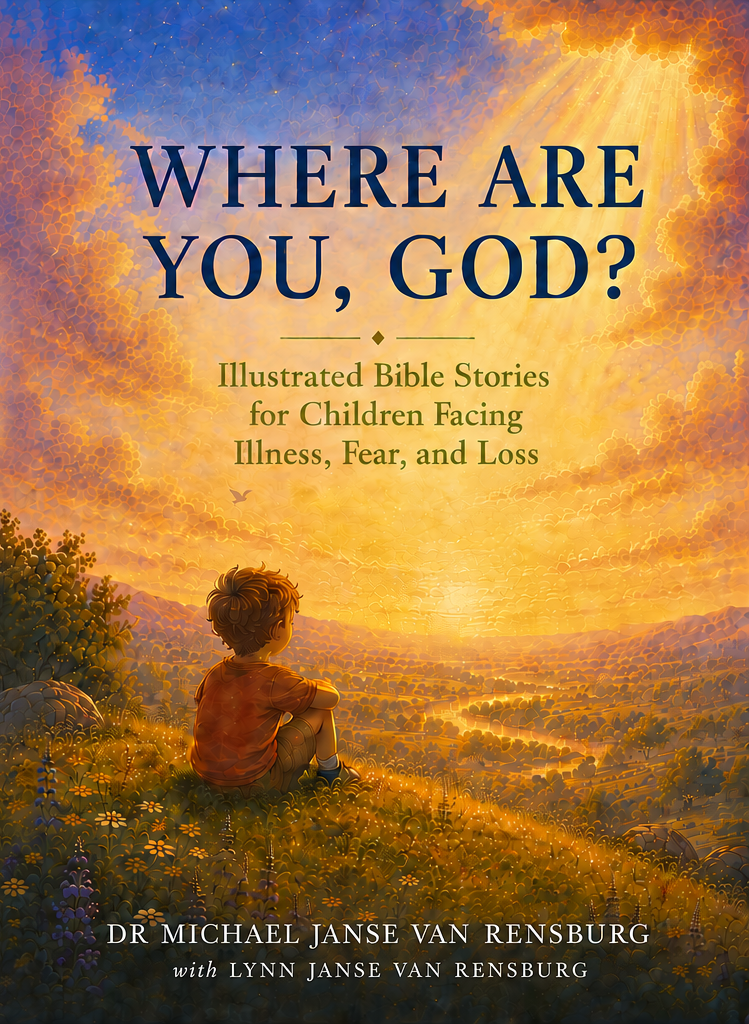
Front cover

Where Are You, God?

Illustrated Bible Stories for Children
Facing Illness, Fear, and Loss

Where Are You, God? · Illustrated Bible Stories for Children Facing Illness, Fear, and Loss

© 2026 Michael Janse van Rensburg. All rights reserved.

No part of this publication may be reproduced, stored in a retrieval system, or transmitted in any form without the prior written permission of the author.

First Edition, 2026
Published by MLTD Janse van Rensburg Publishing

MLTD Janse van Rensburg Publishing logo

ISBN: 978-1-0483-1304-8

Scripture quotations are taken from the World English Bible (WEB), which is in the public domain.

WrittenForLynn.com

For TJ and Daniel —

and for every brave child who has ever asked,

“Where are you, God?”

You are loved.
You are never alone.

A Note for Grown-Ups

If you are reading this book to a child, there is a good chance your family is walking through something hard. Perhaps someone you love is sick. Perhaps there has been a diagnosis, a hospital stay, or a loss. Perhaps a child you care about is carrying fears too big for their small shoulders, and you are looking for gentle words to help. This book was written from inside that very place.

It grew out of our family’s journey through cancer — and out of a search for a book that could sit beside a frightened child and tell the truth gently. Children facing the serious illness of someone they love do not need pretend answers. They need honesty, wrapped in comfort. They need to know that God is near, that their questions are welcome, and that they are not alone.

For our family, these are not only stories. While she was fighting stage 4 cancer, my wife, Lynn, read these very pages aloud to our two boys. Reading was one of the few things she could continue to do most days — and in those quiet moments it became far more than a bedtime routine. It was connection. It was love spoken out loud. It was memories being made, page by page, in the middle of our hardest days. One day our sons will hold this book in their own hands and remember their mother’s voice carrying them through. My prayer is that it might become the same kind of gift in your home — a place where love is shared and held onto, whatever you are walking through.

So here is what this book tries to do, and what it is careful not to do.

It does not promise that everyone always gets better. That would not be true, and children can sense when they are being told something untrue. Instead, every story points to what we can always promise: that God is present, that God loves them, that God hears their prayers, and that nothing — not sickness, not fear, not even death — can separate us from His love.

It makes room for hard feelings. There is a whole section in this book for the days when a child feels angry or confused with God. Those feelings are not a lack of faith. They are part of faith. The Bible is full of people who brought their honest tears and questions straight to God, and He did not turn them away. Your child can do the same.

Each story is built the same way. First comes the Bible story, told simply, for reading aloud. Then a short page called “What This Means for Me,” which gently connects the story to what your child may be feeling. Finally there is a short memory verse and a simple prayer, written in a child’s own voice.

You do not need to have all the answers. You really don’t. When your child asks a question you cannot answer, it is perfectly alright to say, “I don’t know either — but I know God is with us, and I know I love you.” Your presence beside them matters far more than any perfect explanation.

Read slowly. Read the same story again if they ask. Let your child lead. And be gentle with yourself, too. If you are caring for a child through illness or loss, you are carrying a great deal. The God who is near to them is just as near to you.

One more thing, this time for you. This book was born out of our own family’s journey through cancer, and out of the long, frightening days that come with it. If you are the grown-up walking that same road — holding things together while your own heart is unsteady — please know you are not alone. I wrote our story down honestly, with all its fear and all its hope, in a companion book for grown-ups, Where Are You, God? My Wife Has Cancer. If it would be a comfort to walk beside another family who has been where you are, you are warmly welcome to find it at writtenforlynn.com.

You are not alone. You are loved. And God is with you both.

— Michael Janse van Rensburg, Strand, Western Cape, June 2026

Contents

A Note for Grown-Ups
Part 1 · God Is With Us When We Feel Alone
1Hagar in the Desert
2Joseph Through the Hard Years
3God Speaks at the Burning Bush
4Daniel in the Lions’ Den
Part 2 · When We Are Scared
5David and Goliath
6Jesus Calms the Storm
7Peter Walks on the Water
Part 3 · When Someone Is Sick
8Friends Carry a Man to Jesus
9Jairus’ Daughter and the Woman in the Crowd
10Naaman Is Healed
11The Ten Lepers
Part 4 · When We Feel Angry or Confused with God
12Habakkuk Asks God “How Long?”
13Jonah Is Angry with God
14It’s Okay to Say How You Feel
Part 5 · When God Doesn't Answer the Way We Hope
15Job Loses Everything — and Meets God
16Paul’s Thorn
17Jesus Prays in the Garden
Part 6 · When We Feel Sad
18Hannah Prays Through Her Tears
19Elijah Under the Broom Tree
20Jesus Weeps for His Friend
21The Father Runs to His Son
Part 7 · The Power of Prayer
22Jehoshaphat’s Impossible Day
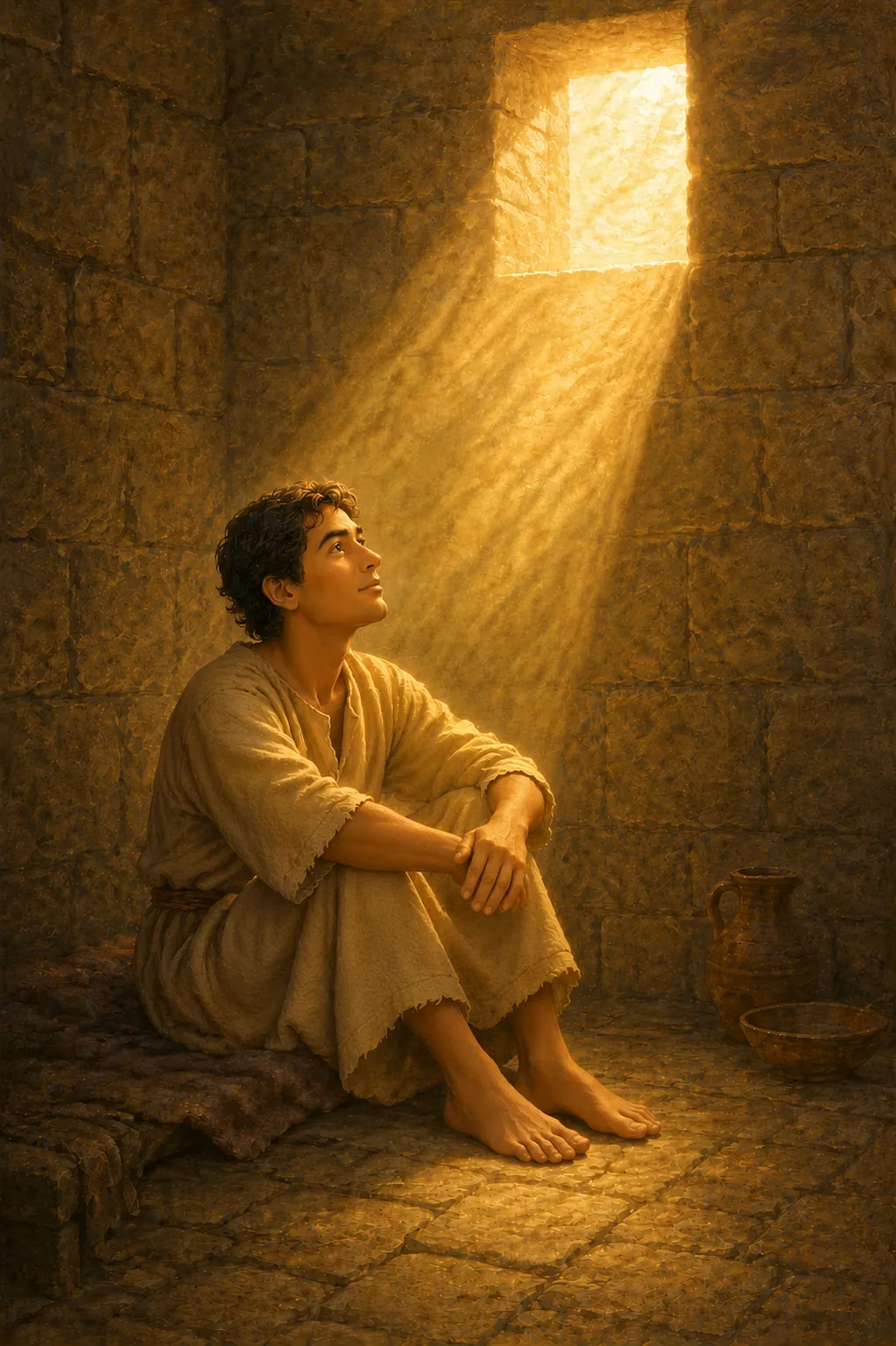
23Paul and Silas Sing in Prison
24The Church Prays for Peter
Part 8 · Family, Friends and Community
25Ruth Stays with Naomi
26Jonathan Encourages David
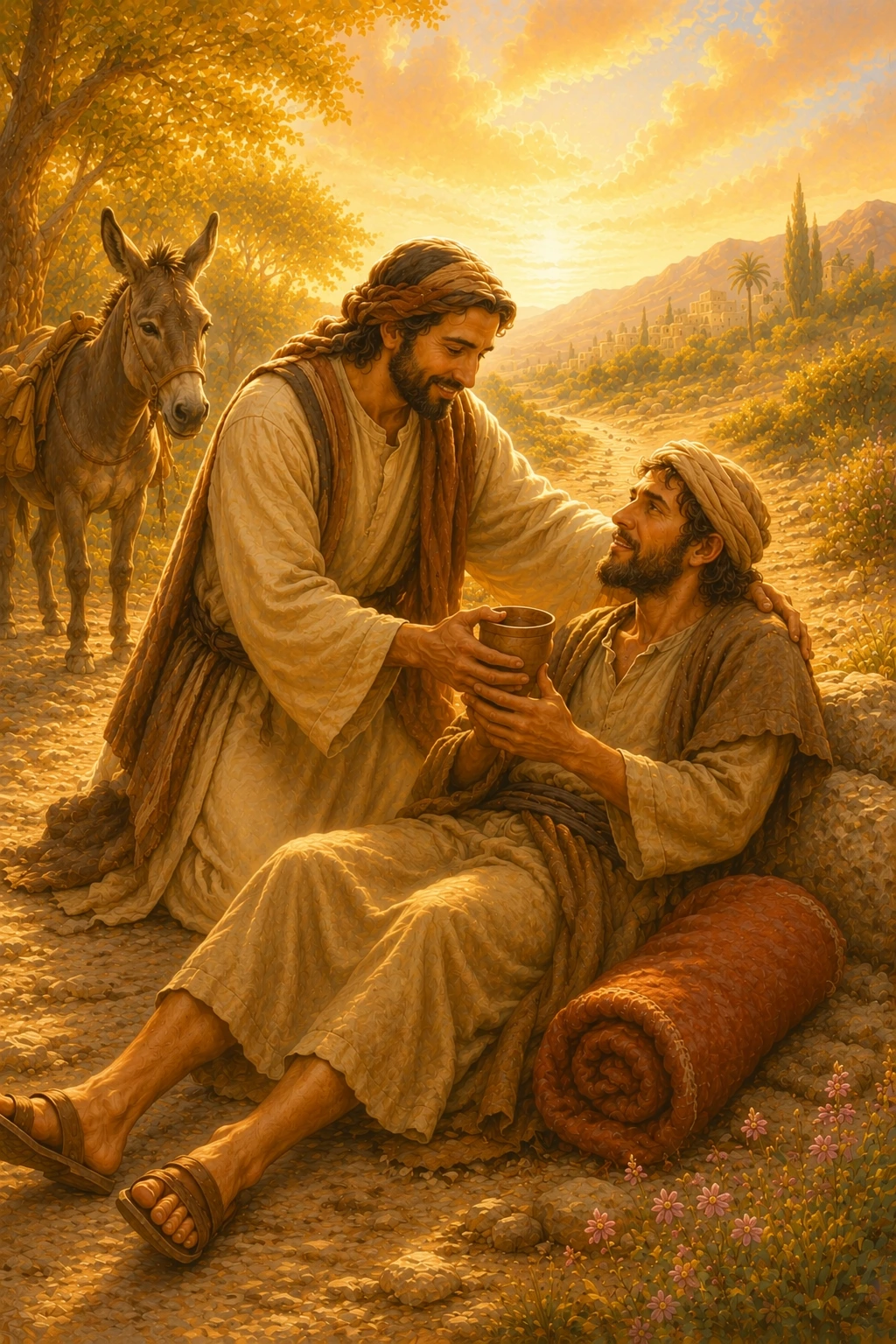
27The Good Samaritan
Part 9 · Hope Beyond Death
28Lazarus Comes Out
29The Man Beside Jesus
30The Saddest Day and the Brightest Morning
31God Makes Everything New
Part 10 · Comfort Psalms
Psalm 23 — The Lord Is My Shepherd
Psalm 27 — The Lord Is My Light
Psalm 46 — God Is Our Refuge
Psalm 91 — Under His Wings
Psalm 121 — My Help Comes from the Lord
Psalm 139 — God Knows Me
About the Author
One
Section
Part One

God Is With Us When We Feel Alone

1Hagar in the Desert
2Joseph Through the Hard Years
3God Speaks at the Burning Bush
4Daniel in the Lions’ Den

Hagar in the Desert

Genesis 16

Long ago, there was a woman named Hagar. She worked as a servant for a family far from her own home. Hagar did not have much, and she did not feel important. Lately, things in the house had become very hard — harsh words, cold looks. Hagar began to feel that nobody wanted her there at all.

One day it became too much. Hagar gathered the little she had and walked out into the desert.

The desert was a big, empty place. The sun was hot. The sand stretched on and on. There were no friends there. There was no family. There was no one to say her name. Hagar found a small spring of water, sat down beside it, and put her face in her hands. “Nobody sees me,” she thought. “Nobody even knows I am here.”

But someone did.

An angel of God found Hagar there in the middle of nowhere. And the very first thing the angel did was say her name. “Hagar,” the angel said gently. “Where have you come from? Where are you going?”

Hagar lifted her head. How did this stranger know her name? In all that huge, empty desert, someone had found her. Someone had seen her tears.

“God has heard you,” the angel told her. “God knows exactly where you are. You are not forgotten. God has a good plan for you and for your little boy who is coming.”

Hagar could hardly believe it. She had felt so invisible. She had felt like the most forgotten person in the whole world. And all that time, God had been watching over her with love.

Hagar wiped her eyes. Then she did something wonderful. She gave God a special name. She whispered, “You are the God who sees me.”

She had run all the way into the desert thinking she was alone. But she was not alone. God had seen her the whole time — in the house, on the road, and beside the lonely spring. God had never once looked away. And God never looks away from you, either.

Hagar in the Desert
Hagar in the Desert

What This Means for Me

When someone you love is very sick, your house can become a busy, worried place. Grown-ups talk in low voices. People hurry in and out. Everyone is thinking about the person who is ill. Sometimes, in the middle of all of it, you can start to feel a little invisible — like nobody notices you, or remembers what you are feeling.

If you have ever felt that way, this story is for you. Hagar felt invisible too. She felt forgotten and alone in a great big desert. But God saw her. God knew her name. God noticed the tears that nobody else noticed.

God sees you in exactly the same way. He sees you when you are brave, and He sees you when you are sad. He sees you when you lie awake at night with a worried tummy. He sees the feelings you do not have words for yet. You are not invisible to God. Not ever. You are seen. You are known. You are loved. And the same God who found Hagar in the desert is right beside you today.

God sees us when we feel alone and forgotten.
Memory Verse
“You are a God who sees.”
Genesis 16:13 (WEB)
Prayer

Dear God,

Sometimes I feel like nobody sees me or knows how I feel inside.

Thank you that you always see me. Thank you that you know my name.

Thank you that I am never, ever alone, because you are always with me.

I am so glad you are the God who sees me. Amen.

Joseph Through the Hard Years

Genesis 37–41; 50

Joseph was a young man with eleven brothers. His father loved him very much and gave him a beautiful coat of many colours. But his older brothers grew jealous. They did not like that their father loved Joseph so. The jealousy grew and grew, until one terrible day the brothers did something cruel — they sold Joseph to strangers who were travelling far away.

Just like that, Joseph lost everything. His home. His father. His safe and ordinary life. The strangers took him all the way to a faraway land called Egypt, where he knew no one at all.

It would have been easy for Joseph to think God had forgotten him. But God had not. The Bible tells us something important about those hard days. It says, again and again: God was with Joseph.

In Egypt, Joseph worked hard in the house of an important man, and God was with him there. But then something unfair happened. Joseph was blamed for something he did not do, and he was thrown into prison — even though he had done nothing wrong.

Prison was a dark and lonely place. Joseph had not chosen any of this. Not being sold. Not Egypt. Not the prison. And yet — God was with Joseph there too. God had not left him in the dark. God was as close to Joseph in that prison as He had ever been.

The years went by slowly. Then one night, the king of Egypt had two strange dreams that frightened him, and nobody could tell him what they meant. Somebody remembered Joseph. “There is a man in prison who understands dreams,” they said.

Joseph was brought before the king. With God’s help, he explained the dreams: a great hunger was coming to the land, and the people needed to get ready. The king was amazed. “No one is as wise as you,” he said. And he gave Joseph a very important job — helping to save the whole country from hunger.

The boy who had been sold by his brothers now helped to feed an entire nation. And years later, when Joseph saw his brothers again, he did not pay them back for their cruelty. He forgave them. “You meant to hurt me,” he told them gently, “but God meant it for good.”

Joseph had walked through so many hard places. But in every single one — the long road, the strange land, the prison — God had never, ever left his side.

Joseph Through the Hard Years

What This Means for Me

Sometimes life changes in ways we never wanted and never chose. A doctor says a word like “cancer.” Someone we love has to go to hospital. Plans we were excited about suddenly stop. None of it feels fair, and none of it is your fault — just as none of Joseph’s hard road was his fault.

Here is the most important thing in Joseph’s whole story. It is not that everything turned out perfectly. It is this: God was with Joseph. In the pit, God was with him. In the prison, God was with him. In every dark and lonely place, God never left.

God does not promise that our road will be easy. But He does promise something even better — that He will never leave us walking it alone. And God is so good and so wise that He can bring good even out of the hardest, saddest times, in ways we may not understand until much later. Whatever hard place you are in today, you are not in it by yourself. God is with you, just as He was with Joseph.

God stays with us even when life goes wrong.
Memory Verse
“God meant it for good.”
Genesis 50:20 (WEB)
Prayer

Dear God,

Some things in my life feel hard and unfair, and I did not choose them.

Thank you that you were with Joseph in every hard place.

Thank you that you are with me too, and that you never leave me alone.

Please help me to trust that you can bring good, even when I cannot see how. Amen.

God Speaks at the Burning Bush

Exodus 3

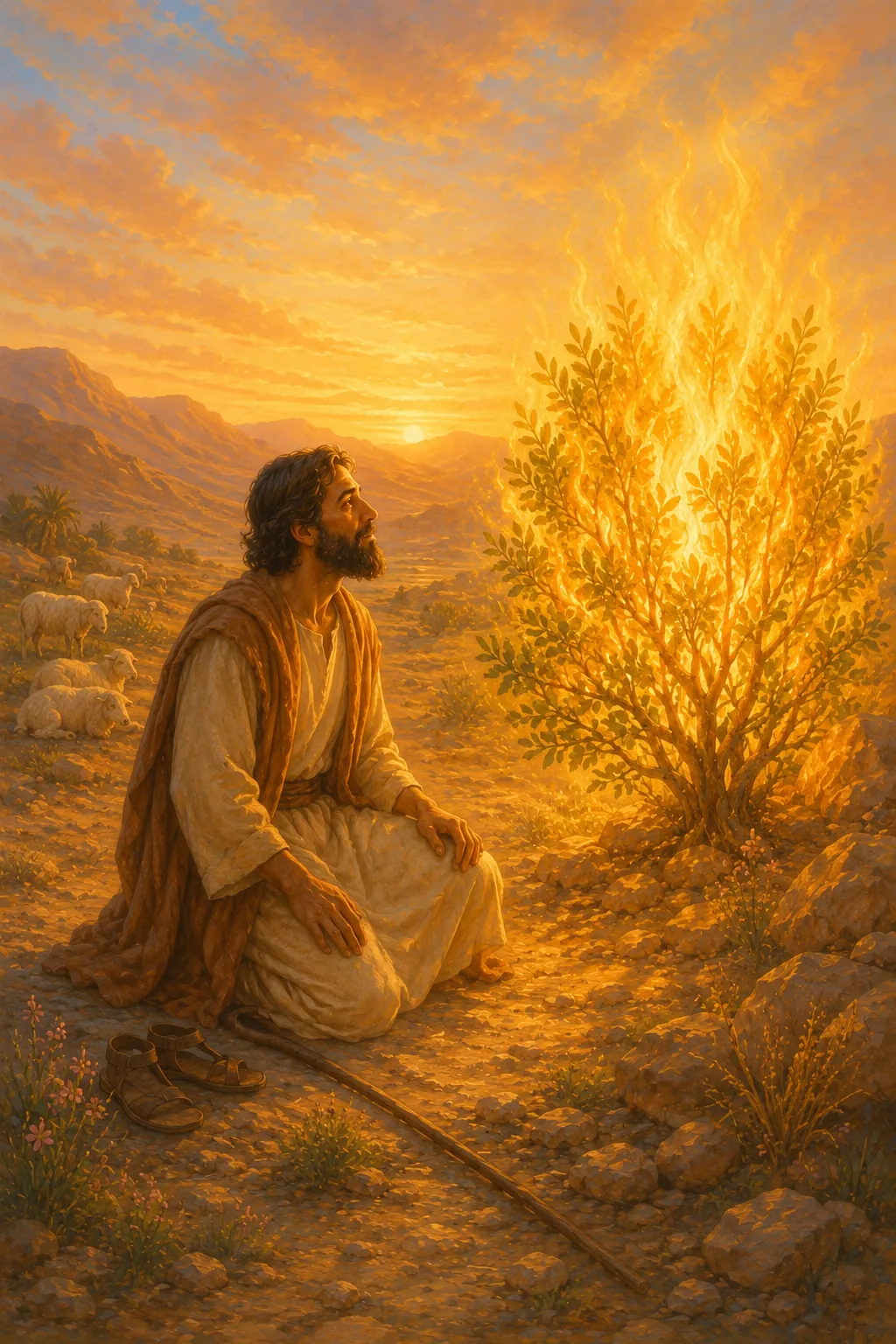
Moses was a long way from home, looking after sheep on the side of a quiet mountain. The desert was still. The day was ordinary. And then Moses saw something that made him stop and stare.

A bush was on fire.

But this was no ordinary fire. The bush burned and burned — yet it did not burn up. The flames danced, but the leaves stayed green. Moses had never seen anything like it. “I must go closer and look,” he said.

As he came near, a voice called to him from the middle of the fire. It called him by name. “Moses! Moses!”

“Here I am,” Moses answered, his heart beating fast.

“Do not come any closer,” said the voice. “Take off your sandals, for the place where you are standing is holy ground.” Moses slipped off his sandals. He covered his face, because he knew that he was standing before God Himself.

Then God said something that mattered very much. “I have seen my people suffering. I have heard them crying. I know all about their pain. And I have come down to rescue them.”

God had seen. God had heard. God had not been far away and uncaring — God had come close.

Then God told Moses the plan. “I am sending you to help set my people free.”

Moses felt suddenly very small. “Who am I?” he said. “I am not important enough. I am not brave enough. I cannot do this.”

And God did not say, “Yes you are. You are big and strong and brave.” God said something far better. He said: “I will be with you.”

That was the promise Moses needed. He did not have to be big enough on his own. He did not have to be brave all by himself. God — the God who made the stars — would go with him every single step. Moses was still a little afraid. But now he was not alone in his fear. And that changes everything.

God Speaks at the Burning Bush

What This Means for Me

Is there something ahead of you that feels scary? Maybe it is a visit to the hospital, or a needle, or a hard conversation. Maybe it is a change at home that you did not want. Maybe you do not even know exactly what you are afraid of — only that your tummy feels tight when you think about tomorrow.

Moses felt afraid of what was ahead, too. He looked at the big, hard thing in front of him and said, “I am not enough for this.” And do you know what God said? He did not say, “Be braver.” He did not say, “You are big enough.” He said, “I will be with you.”

That is God’s promise to you as well. You do not have to be brave all by yourself. You do not have to be big enough to carry the scary thing alone. The same God who came close to Moses comes close to you — right into the middle of whatever frightens you most. You are not facing it on your own. And when God is with you, even scary things become a little less scary.

God comes close when we are afraid of what is ahead.
Memory Verse
“Certainly I will be with you.”
Exodus 3:12 (WEB)
Prayer

Dear God,

There are some things ahead that make me feel scared and small.

Thank you that you came close to Moses and promised to be with him.

Thank you that you promise to be with me too.

When I am afraid, please help me to remember that I am never alone — because you are right here. Amen.

Daniel in the Lions’ Den

Daniel 6

Daniel loved God with all his heart. Every day, three times a day, he would kneel down by his open window and pray. Praying was as natural to Daniel as breathing. It was how he talked to the God he loved.

Daniel was so good and so wise that the king wanted to give him the most important job in the whole kingdom. But this made some of the other men terribly jealous. They wanted to get Daniel into trouble. So they came up with a sneaky plan.

They tricked the king into making a new law: for thirty days, nobody was allowed to pray to anyone except the king. Anyone who broke the law would be thrown into a den of hungry lions.

When Daniel heard about the new law, what do you think he did? He went home, opened his window just as he always did, knelt down, and prayed to God. Daniel was not going to stop talking to the God he loved — not even to save himself.

The jealous men were watching. They ran straight to the king. And even though the king liked Daniel very much and was terribly sad, the law could not be undone. Daniel was taken to the den of lions.

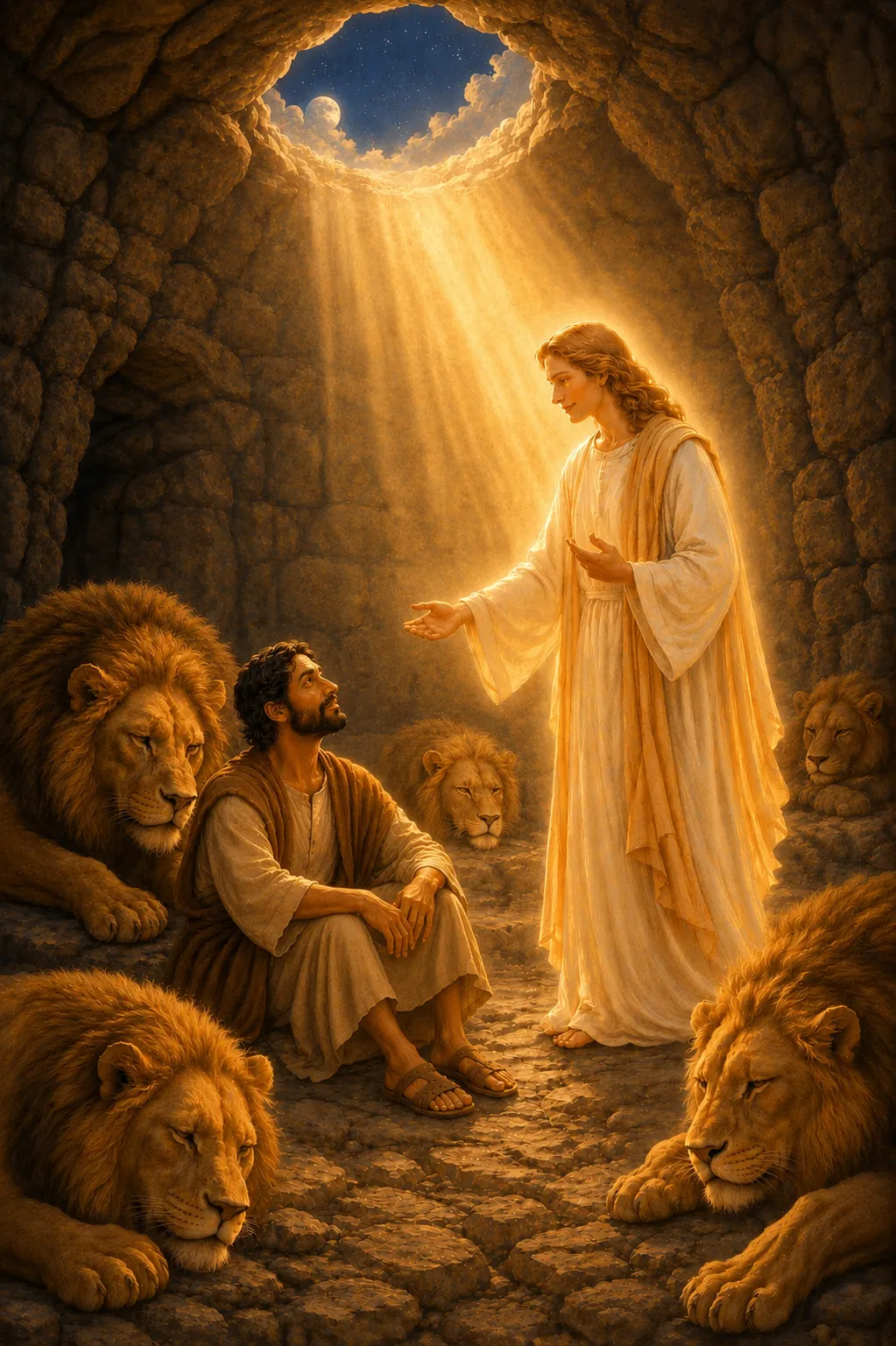
The lions’ den was the scariest place anyone could imagine. It was dark. It was deep. And it was full of huge, hungry lions. A great stone was rolled across the top.

That night, the king could not sleep at all. He paced up and down, worrying about Daniel in the dark.

But Daniel was not alone in that den. God had sent an angel — and the angel shut the lions’ mouths tight. The great lions lay down as gently as kittens. All night long, in the darkest, most frightening place, God was right there with Daniel.

When morning came, the king rushed to the den. “Daniel!” he called out. “Daniel, are you there? Was your God able to keep you safe?”

And out of the darkness came Daniel’s voice, calm and sure. “My God sent His angel,” Daniel said, “and shut the lions’ mouths.”

Daniel walked out without a single scratch. He had spent the whole night in the scariest place in the world — and God had been with him through every dark hour.

Daniel in the Lions’ Den

What This Means for Me

Everybody has a “lions’ den.” It is the place, or the time, that scares you most. Maybe yours is your dark bedroom at night, when the worries get loud. Maybe it is a hospital, with its strange smells and beeping machines. Maybe it is the heavy, scary feeling that comes when someone you love is very sick.

Daniel was put right in the middle of the scariest place he could imagine. But here is the wonderful thing — he was not alone there. God was with him in the dark, all night long.

God does not always take the scary place away. The den was still a den. The night was still long. But God was inside it with Daniel, keeping him company through every hour. When you are in your own “lions’ den,” God is in there with you too. He does not leave you at the door and wait outside. He comes right down into the dark place beside you and stays. You may still feel afraid — and that is okay. But you are never, ever alone in the dark. The God who was with Daniel is with you tonight, and every night.

God is with us in the place we fear the most.
Memory Verse
“My God has sent his angel, and has shut the lions’ mouths.”
Daniel 6:22 (WEB)
Prayer

Dear God,

Sometimes I feel like I am in a scary place, like Daniel in the lions’ den.

Thank you that you were with Daniel all night long in the dark.

Thank you that you are with me in my scary places too.

When I am afraid, help me to remember that I am never alone, because you are right here beside me. Amen.

Two
Section
Part Two

When We Are Scared

5David and Goliath
6Jesus Calms the Storm
7Peter Walks on the Water

David and Goliath

1 Samuel 17

Two armies stood facing each other across a wide valley. On one side were God’s people, the Israelites. On the other side were their enemies, the Philistines. And the Philistines had a secret weapon: a giant.

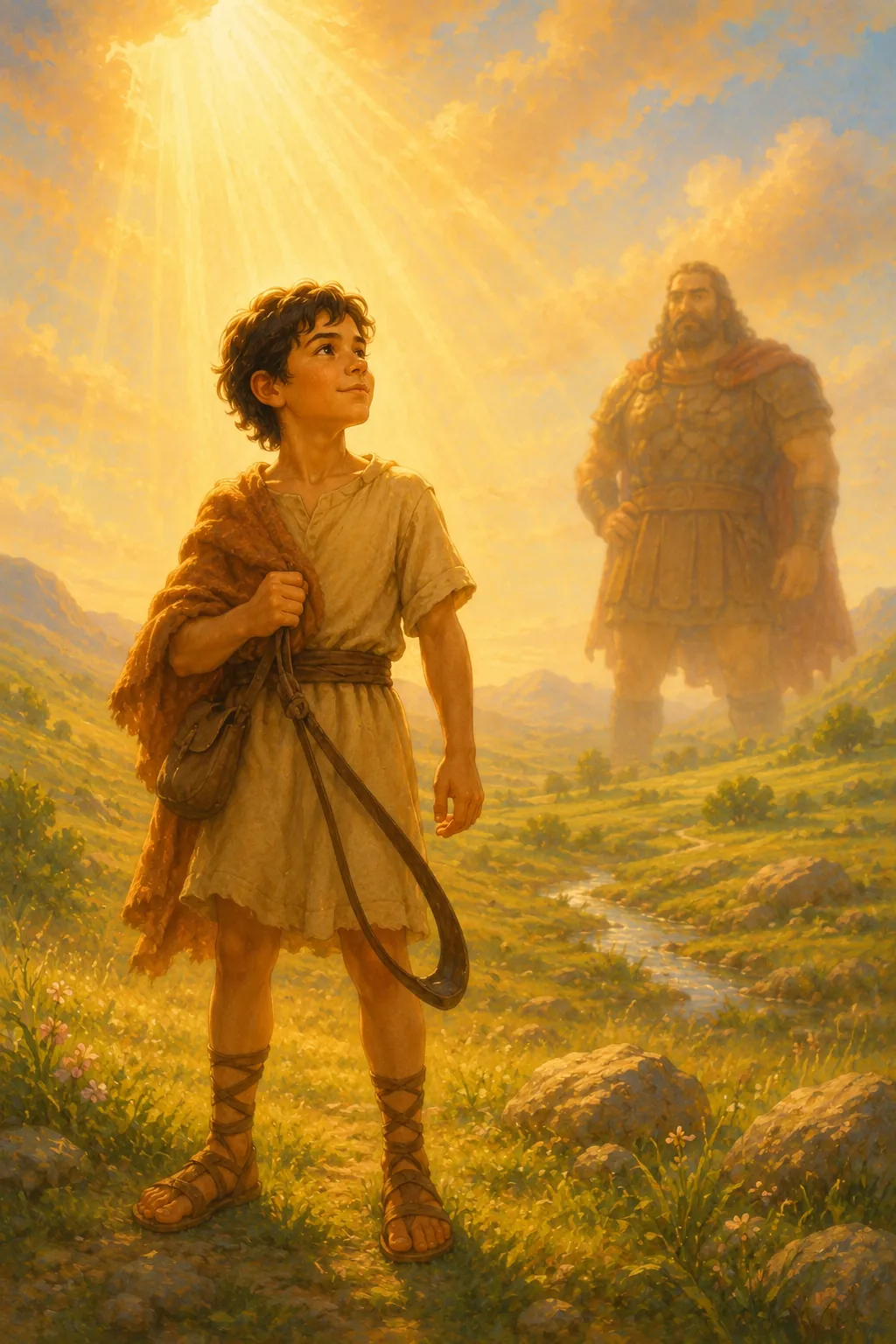
His name was Goliath, and he was enormous. He was taller than the tallest man, with heavy armour that flashed in the sun and a spear like a great wooden beam. Every morning and every evening, Goliath stomped out in front of the armies and roared, “Send me a man to fight! Who is brave enough?”

Nobody was. The soldiers of Israel took one look at the giant and shook with fear. Not one of them would go.

Now, there was a young shepherd boy named David. He was the youngest in his family — too young to be a soldier. One day his father sent him to the valley to bring food to his older brothers. And while David was there, he heard the giant roaring his challenge.

David looked around. Why was everyone so afraid? “Who is this giant,” he said, “that he thinks he can shout against the army of the living God?”

David was not afraid, because David knew something the soldiers had forgotten. He knew how big God was.

When David offered to fight the giant, people laughed. “You are only a boy!” But David said, “When I looked after my father’s sheep, a lion came, and a bear came. God helped me protect the sheep from both. The same God will help me now.”

The king tried to dress David in heavy armour, but it was far too big. So David took it off. Instead, he picked up his shepherd’s sling and five smooth stones from the stream. Then he walked out to meet the giant.

Goliath laughed a great booming laugh. “Am I a dog, that you come at me with sticks?”

But David called back, strong and clear, “You come to me with a sword and a spear. But I come to you in the name of the Lord. The battle belongs to God!”

David reached into his bag, fitted a stone to his sling, and swung it round and round. The stone flew straight and true — and the mighty giant fell down to the ground.

The little shepherd boy had done what a whole army could not. Not because David was big. Not because David was strong. But because the God who was with him was bigger than any giant in the world.

David and Goliath
David and Goliath

What This Means for Me

Sometimes the thing in front of you feels like a giant — too big, too loud, too scary. When someone you love is very sick, the worry can feel like a giant standing over your whole family, roaring every single day. It can make you feel as small as David looked.

But here is what David knew, and what you can know too: the giant is never bigger than God. David did not win because he was the biggest or the bravest. He was a young boy with a sling. He won because God was with him, and God was bigger than the giant.

Your giant — the sickness, the fear, the long waiting — is not bigger than God either. You do not have to be big enough or brave enough to beat it on your own. You do not have to fight it alone. The same God who stood with a shepherd boy in the valley stands with you. And there is no giant, anywhere, that is bigger than Him.

Big problems are never bigger than God.
Memory Verse
“When I am afraid, I will put my trust in you.”
Psalm 56:3 (WEB)
Prayer

Dear God,

Sometimes the things I am facing feel as big as a giant.

Thank you that you are bigger than anything that scares me.

Thank you that I do not have to be brave on my own, because you are with me.

When I am afraid, help me to put my trust in you. Amen.

Jesus Calms the Storm

Mark 4:35–41

It had been a long day. Evening was coming, and Jesus said to His friends, “Let’s go across to the other side of the lake.” So they climbed into a boat and set off across the water.

Jesus was tired. He found a cushion at the back of the boat, lay down, and fell fast asleep.

Then, out of nowhere, a storm blew in.

The wind screamed. The sky turned black. Huge waves rose up taller than the boat and crashed down over the sides, and cold water began to fill it up. The little boat was tossed up and down and side to side, like a leaf in a river.

Jesus’ friends grabbed buckets and tried to throw the water back out, but it came in faster than they could scoop. And some of these friends were fishermen — they had been on this lake all their lives, in all kinds of weather. If even they were frightened, then this was a very bad storm indeed. “We’re going to sink!” they cried. “We’re going to drown!”

And through it all, Jesus lay sound asleep on His cushion at the back of the boat, as peaceful as could be.

The friends could not believe it. They shook Him awake. “Teacher!” they shouted over the roaring wind. “Don’t you care that we are about to drown?”

Jesus opened His eyes. He stood up in the rocking boat. He looked out at the wild wind and the crashing waves. And He said just three words.

“Peace. Be still.”

At once, the wind stopped. The waves lay down flat. The lake went smooth and quiet, as calm as a sleeping baby. Everything was still.

The friends stood dripping wet, looking around at the calm water. A moment ago they had been shouting and fearing for their lives. Now there was not even a ripple.

Jesus turned to His friends. “Why were you so afraid?” He asked gently. “Do you still not trust me?”

The friends sat in the quiet boat with their mouths open. They looked at one another and whispered, “Who is this? Even the wind and the waves do what He says!”

They had been so frightened. But Jesus had been in the boat with them the whole time — and Jesus was never afraid at all.

Jesus Calms the Storm

What This Means for Me

When someone you love is sick, life can feel like a storm. Everything seems to be tossing and crashing. Nobody feels in control. And sometimes you might be scared that the whole boat — your whole family — is going to sink.

Sometimes, in the middle of the storm, it can even feel like Jesus is asleep. Like He doesn’t notice. Like He doesn’t care. Jesus’ friends felt exactly that way. But look closely at the story: Jesus had not left the boat. He was right there with them the entire time. And He was not worried for even one second, because He is stronger than any storm.

Jesus is in your boat too. He may seem quiet. The storm may not become calm as quickly as you wish it would. But quiet is not the same as gone. Jesus is with you in the wind and the waves, and He is far bigger than anything that frightens you. You are not going to sink. He is in the boat.

Jesus is with us in life’s storms, even when He seems quiet.
Memory Verse
“Peace! Be still!”
Mark 4:39 (WEB)
Prayer

Dear Jesus,

Sometimes my life feels like a scary storm, and I am afraid the boat will sink.

Thank you that you are in the boat with me and you are never afraid.

Thank you that you are stronger than any storm.

When I am frightened, help me to remember that you are right here. Amen.

Peter Walks on the Water

Matthew 14:22–33

One evening, after a very long day, Jesus told His friends to get into their boat and sail on ahead of Him across the lake. Then Jesus went up a mountain by Himself to pray, alone in the quiet.

Out on the water, the wind picked up. The waves grew bigger and bigger, and the boat was a long way from land. The friends rowed and rowed, but the wind kept pushing them back, again and again. Their arms ached. The night was dark and cold, and Jesus was not with them in the boat. They struggled like this for hour after hour, all through the long night.

Then, very early in the morning, while it was still dim, the friends saw something that made their hearts jump into their throats. Someone was walking toward them — walking on top of the water!

“It’s a ghost!” they cried out in fear.

But a kind, familiar voice came across the waves. “Take courage! It is I. Don’t be afraid.” It was Jesus.

Peter, one of the friends, called out, “Lord, if it’s really you, tell me to come to you on the water.”

“Come,” said Jesus.

So Peter climbed over the side of the boat and stepped out onto the water. And he did not sink! Keeping his eyes on Jesus, Peter walked across the top of the waves toward him. He was really doing it!

But then Peter looked away from Jesus. He looked at the wind. He looked at the big, dark waves all around his feet. And the moment he stopped looking at Jesus and started looking at the storm, he became afraid — and he began to sink down into the water.

“Lord, save me!” Peter cried.

Straight away — not in a minute, not after a while, but immediately — Jesus reached out His hand and caught hold of Peter. He lifted him up safe. “Why did you doubt?” Jesus asked kindly. “I was right here.”

Together they climbed into the boat, and the wind died down. And all the friends looked at Jesus in wonder and said, “Truly, you are the Son of God.”

Peter Walks on the Water

What This Means for Me

When we are scared, we usually stare at the scary thing. We look at the waves. Peter did just fine as long as he kept his eyes on Jesus — but the very moment he looked at the storm instead, he began to sink.

It is the same for us. When someone we love is sick, there are so many frightening “waves” we could stare at: the worry, the hospital, the things we cannot fix. We get to choose where we look. Keeping our eyes on Jesus does not make the waves disappear — they were still there all around Peter. It means we are looking at the One who is stronger than the waves.

And here is the very best part of the whole story. The instant Peter began to sink and called out, “Lord, save me!”, Jesus caught him right away. He did not wait. He will not wait for you either. Even when your eyes slip back to the scary things and you feel yourself sinking, Jesus is close enough to catch you the moment you call. He is always reaching out His hand.

When we are afraid, we can keep our eyes on Jesus.
Memory Verse
“Don’t be afraid.”
Matthew 14:27 (WEB)
Prayer

Dear Jesus,

When I am scared, I look at all the things that worry me, just like Peter looked at the waves.

Help me to keep my eyes on you instead.

Thank you that the moment Peter called out, you caught him straight away.

Thank you that you will always catch me too. Amen.

Three
Section
Part Three

When Someone Is Sick

8Friends Carry a Man to Jesus
9Jairus’ Daughter and the Woman in the Crowd
10Naaman Is Healed
11The Ten Lepers

Friends Carry a Man to Jesus

Mark 2:1–12

There was a man who could not walk. His legs did not work, and so he spent his days lying on a mat. He could not go anywhere unless someone carried him.

But this man had wonderful friends — four of them. And these four friends loved him very much.

One day, news spread through the town: Jesus was here, and He was in a house nearby, teaching. The four friends looked at one another. They knew Jesus could help. “Let’s carry our friend to Him,” they said. So they picked up the four corners of his mat and set off.

But when they arrived, their hearts sank. The house was packed full of people. There were so many that the crowd spilled out of the door and into the street. There was no way in. Not even a tiny gap.

Most people would have given up and gone home. But not these four friends. They loved their friend too much to give up.

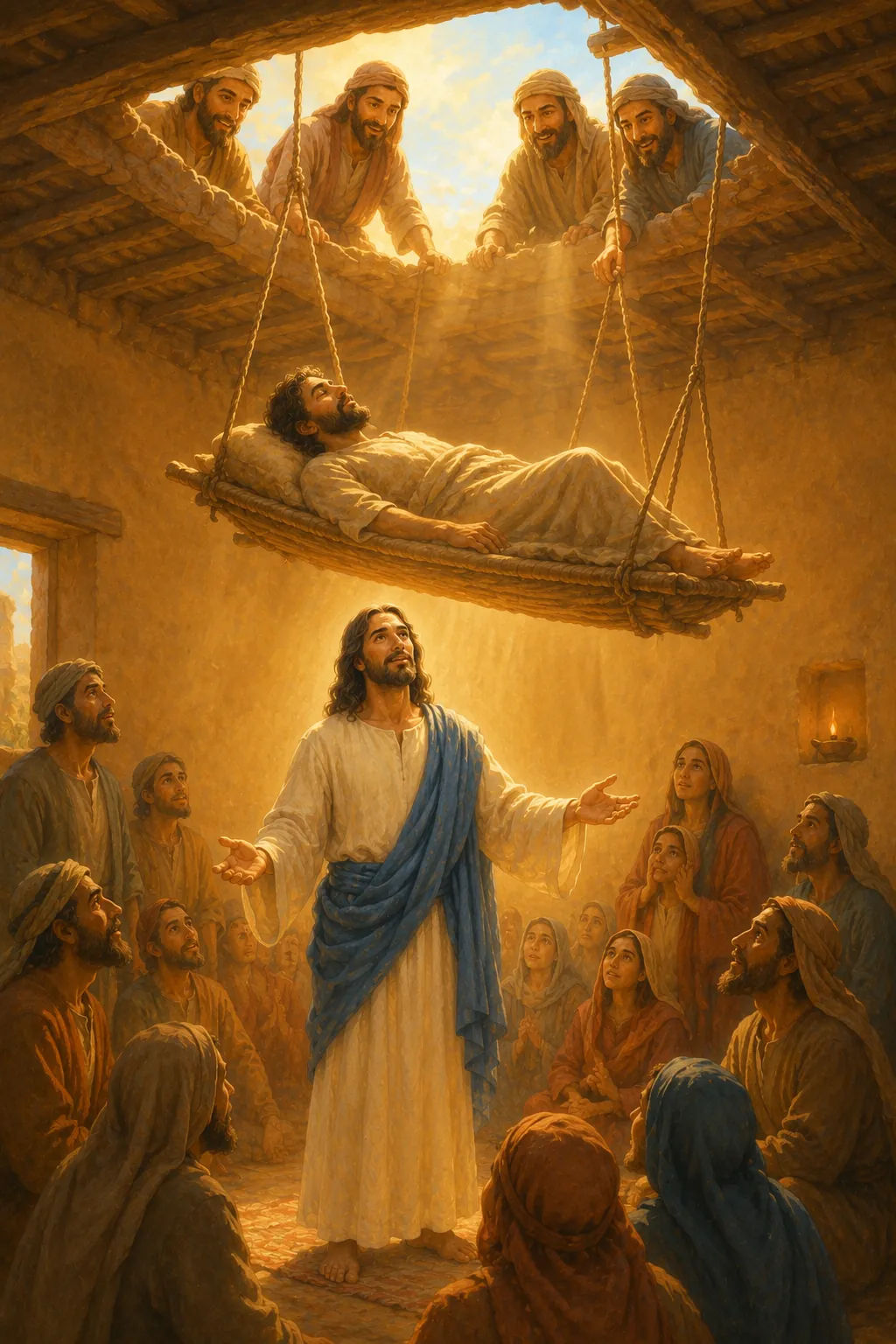
“The roof!” one of them said. In those days, houses had flat roofs with steps going up the side. So, very carefully, the four friends carried their friend, mat and all, up onto the roof. Then they began to make an opening — digging through the roof until they had made a hole big enough.

Down below, Jesus was teaching. Imagine the surprise when bits of the roof started coming loose, and then a man on a mat was slowly, carefully lowered down on ropes — right into the middle of the room, right in front of Jesus.

Jesus looked up at the four friends peering through the hole in the roof. He saw how much they believed. He saw their love. And He was pleased.

Then Jesus looked at the man on the mat and said something amazing. “Get up,” he said. “Pick up your mat, and go home.”

And the man did. His legs, which had never worked, suddenly grew strong. He stood up. He rolled up his mat. And he walked out of that house on his own two feet, while everyone stared in wonder and praised God.

It all began because four friends loved him enough to carry him to Jesus.

Friends Carry a Man to Jesus

What This Means for Me

When someone we love is very sick, we often wish we could fix it. But we are not doctors, and we cannot make the sickness go away. That can leave us feeling small and helpless.

This story shows us something we CAN do — something powerful. The four friends could not heal their friend either. But they could carry him to Jesus. And that is exactly what love does.

You can do the very same thing. When you pray for someone you love, you are carrying them to Jesus, just like the four friends carried their friend up to the roof. Your prayers are the ropes that lower them gently down in front of him. You do not need to be big or strong or clever. You just need to love them enough to bring them to Jesus.

God does not always heal the body the way He healed this man — sometimes the people we pray for stay sick for a long time, and that is a hard and sad thing. But Jesus always, always welcomes the people we carry to Him. He never turns them away. And His love is the deepest healing of all.

Love does something — we can bring the people we love to Jesus.
Memory Verse
“Bear one another’s burdens.”
Galatians 6:2 (WEB)
Prayer

Dear Jesus,

Thank you for the four friends who carried their friend to you.

I want to carry the people I love to you, too.

Right now I bring to you someone who is sick, and I ask you to be near to them.

Thank you that you always welcome the people we bring. Amen.

Jairus’ Daughter and the Woman in the Crowd

Mark 5:21–43

A great crowd pressed around Jesus, everybody wanting to be close to Him. Then a man named Jairus pushed through and fell down at Jesus’ feet. He was an important man in the town, but right now he was just a frightened father.

“My little daughter is so sick,” he begged. “She is dying. Please, please come and put your hands on her.” Jesus looked at him kindly and went with him at once.

Now, in that same pushing, bustling crowd, there was a woman who had been sick for twelve long years. She had been to many doctors. She had spent all her money. And still she only grew worse. She was tired and sad and lonely.

But she had heard about Jesus. And she thought, “If I can just touch His clothes, I will be made well.”

So she reached out through the crowd, stretched out her hand, and touched the edge of His coat. And at that very moment, she felt the sickness leave her body. She was well!

Jesus stopped walking. “Who touched me?” He asked.

His friends were puzzled. “Look at this huge crowd pressing all around you! What do you mean, who touched you?” But Jesus kept looking around, searching the faces.

The woman came forward, trembling. She fell down before Him and told Him the whole truth. In all that enormous crowd, Jesus had noticed her — one hurting woman that everybody else had pushed past.

Jesus looked at her with such love. “Daughter,” he said — daughter — “your faith has made you well. Go in peace.”

Just then, sad news came from Jairus’ house: “Your little girl has died. Don’t bother the teacher anymore.” Jairus’ heart broke. But Jesus turned to him and said gently, “Don’t be afraid. Just believe.”

They went to the house, where everyone was crying. Jesus walked in, took the little girl’s hand, and said softly, “Little girl, get up.” And she opened her eyes, and stood up, and walked! Her parents could hardly believe their joy. And Jesus, ever so tenderly, told them to give her something to eat.

Jairus’ Daughter and the Woman in the Crowd

What This Means for Me

Look at how busy Jesus was. A whole crowd was pushing around Him. An important man was begging Him to hurry. And right in the middle of all of it, Jesus stopped — for one sick woman that everyone else had ignored.

When someone we love is very sick, the world can feel like that giant, pushing crowd. Everyone is rushing. Big, scary things are happening. And it is easy to feel like a small, invisible person that nobody notices.

But Jesus is never too busy for one person. He noticed the woman in the crowd, and He called her “daughter.” He cared about a worried father and his little girl. And He notices you, exactly the same way. You are not invisible to Jesus. He sees your worry. He cares about your family. To Him, you are never just one face in a crowd — you are precious, and He knows your name.

Jesus is never too busy to notice one suffering person, or one worried family.
Memory Verse
“Don’t be afraid. Just believe.”
Mark 5:36 (WEB)
Prayer

Dear Jesus,

Sometimes I feel like nobody notices me, like I am lost in a big crowd.

Thank you that you are never too busy for me.

Thank you that you see me, and you care about my family.

When I am afraid, help me to trust you. Amen.

Naaman Is Healed

2 Kings 5

Naaman was a great and powerful man. He was the commander of a whole army, and everyone respected him. But Naaman had a problem that all his power could not fix: he had a sickness on his skin, and there was no medicine that could cure it.

Now, in Naaman’s house there was a young servant girl. She had been taken far from her home in Israel. She was only a child, and she had every reason to be unhappy. But she had a kind heart. And she knew about God.

“If only my master would go to the prophet in Israel,” she said to Naaman’s wife. “God’s prophet Elisha could heal him.”

It was a small thing for a little girl to say. But that small thing changed everything.

Naaman travelled a long way, with horses and chariots and bags of treasure, and arrived at the house of Elisha the prophet. But Elisha did not even come outside. He simply sent a messenger with these words: “Go and wash seven times in the Jordan River, and you will be well.”

Naaman was furious. “I thought he would come out and wave his hand and do something grand!” he grumbled. “And the Jordan? It’s just a muddy little river!” He turned to leave in a huff.

But his servants came to him gently. “Master,” they said, “if the prophet had asked you to do something big and difficult, you would have done it. So why not do this simple little thing? Just go and wash.”

Naaman stopped. He swallowed his pride. Then he went down to the Jordan River and dipped himself under the water — once, twice, three times, all the way to seven.

And when he came up the seventh time, his skin was healed completely — as fresh and clean as the skin of a little child.

Naaman could hardly believe it. He went back to Elisha full of joy and said, “Now I know that there is no God in all the world like the God of Israel.” The great commander had been healed — and it had all started with the kind words of a little servant girl.

Naaman Is Healed
Naaman Is Healed

What This Means for Me

God cared about Naaman, the great and important commander. And God cared just as much about the little servant girl who had been taken far from home. Big or small, important or forgotten — God cares about every single person.

That means God cares about you, too. You do not have to be powerful or grown-up or important for God to notice you and love you. He cares about the sick, and He cares about the people who love them.

And look at how God worked. The great healing did not start with a powerful king or a grand and fancy plan. It started with one small, kind girl who said a few brave words about God. She was only a child — and God used her to help a mighty man.

Never think you are too small to matter to God, or too small to help. Your prayers matter. Your kindness matters. A small word of hope from you might be exactly what someone needs. God loves to do big things through small people who trust Him.

God cares about sick people, great and small.
Memory Verse
“He heals the broken in heart, and binds up their wounds.”
Psalm 147:3 (WEB)
Prayer

Dear God,

Thank you that you care about every person — the great and the small.

Thank you that you care about me, even though I am young.

Thank you that you can use even a small child to do good.

Help me to trust you and to be kind to others. Amen.

The Ten Lepers

Luke 17:11–19

Jesus was walking along a road between two towns when ten men called out to Him. They were standing far away, keeping their distance, because they all had a skin sickness that meant they were not allowed to come close to other people. They were lonely, and they had been lonely for a very long time — not allowed to live in their own homes, not allowed to hug the people they loved.

“Jesus! Master!” they shouted across the gap. “Have pity on us! Please help us!”

Jesus saw them, and His heart was full of kindness. “Go,” He told them, “and show yourselves to the priests.” (In those days, the priest was the one who could say a person was well again.)

Now here is the wonderful part. The ten men were not healed right away. They had to start walking first, trusting Jesus’ words. And as they went — as they walked down that road — their skin began to clear, and they realised they were well!

All ten of them were healed! Can you imagine their joy? After all that time of being kept far away, they could finally go home. They could hug their families again. They could sit around the supper table. They could go back to being ordinary, happy people. It was the best day of their lives.

But only one of them stopped.

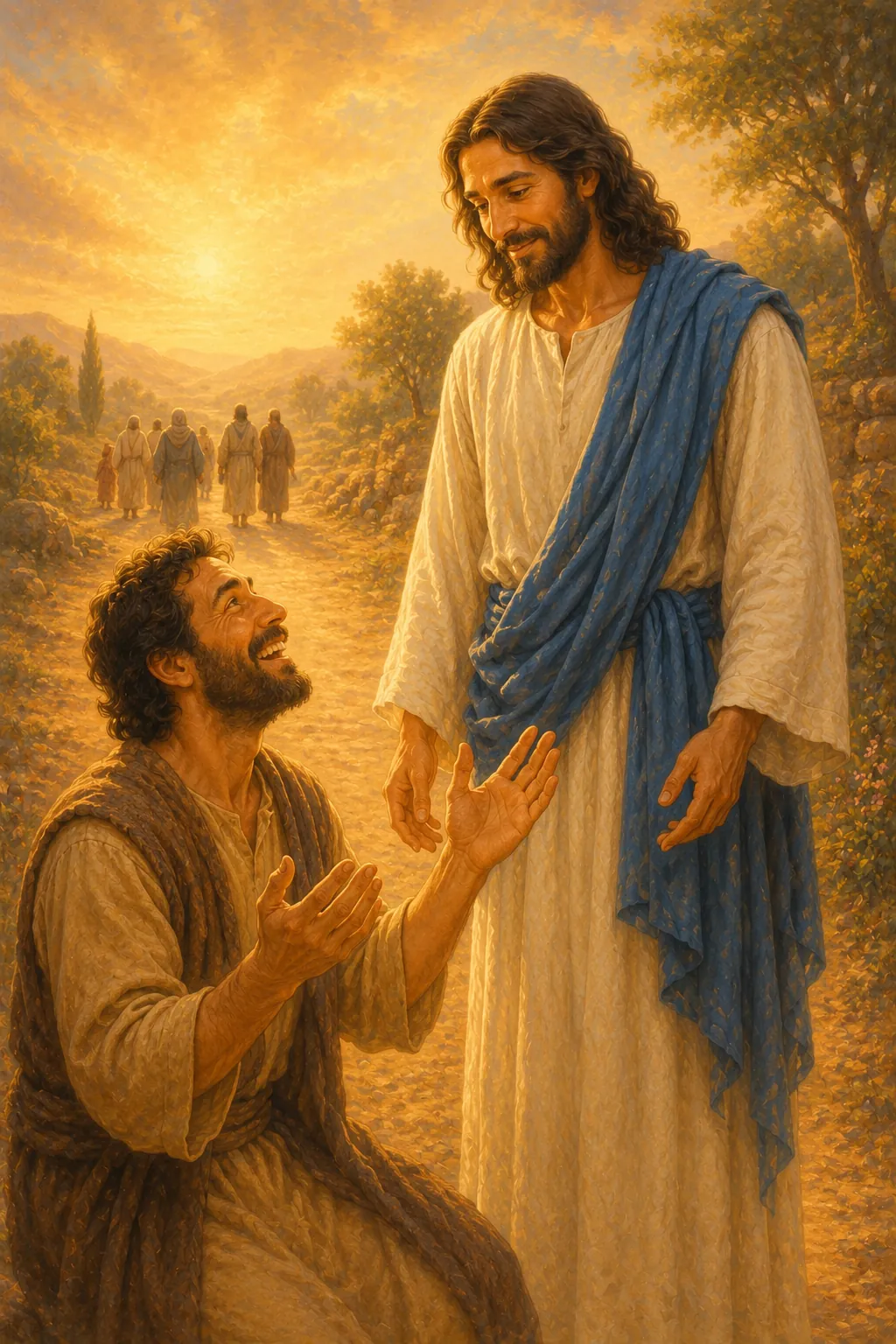
When this one man saw that he was healed, he turned right around. He came running back to Jesus, praising God at the top of his voice. He threw himself down at Jesus’ feet and said, “Thank you! Thank you!” And this man was a foreigner — a Samaritan — someone people did not expect to come back.

Jesus looked around. “Weren’t all ten of you healed?” He asked. “Where are the other nine? Did only this one come back to say thank you to God?”

Then Jesus said warmly to the man kneeling before Him, “Stand up and go on your way. Your faith has made you well.”

Nine men received a wonderful gift and kept on walking. But one man turned back to say thank you — and he found something extra: the deep, warm joy of being thankful.

The Ten Lepers
The Ten Lepers

What This Means for Me

When life is hard, it is easy to see only the hard things. When someone we love is sick, the worry can fill up our whole hearts until there is no room left to notice anything good.

But this story teaches us something gentle and helpful. Even on hard days, there are still small gifts from God all around us — a kind nurse, a sunny morning, a warm hug, a good moment, a friend who remembers us. Saying “thank you” to God does not mean pretending everything is fine. It means looking for the little bits of His goodness that are shining even in the middle of a hard time.

The one man who came back found more than healing — he found joy. And the same is true for us. When we stop to thank God, even for small things, even on hard days, it helps our hearts to see that He is still good, still here, and still loving us. Thankfulness is a gift we give back to God — and it warms our own hearts too.

We can thank God for His goodness even in the middle of hard times.
Memory Verse
“In everything give thanks.”
1 Thessalonians 5:18 (WEB)
Prayer

Dear God,

Some days are hard, and it is easy to forget the good things.

Help me to be like the one man who came back to say thank you.

Thank you for the small gifts you give me every day.

Thank you that you are good, even when life is hard. Amen.

Four
Section
Part Four

When We Feel Angry or Confused with God

12Habakkuk Asks God “How Long?”
13Jonah Is Angry with God
14It’s Okay to Say How You Feel

Habakkuk Asks God “How Long?”

Habakkuk 1–3

Habakkuk was a man who loved God. He was one of God’s prophets. But when Habakkuk looked around at the world, his heart became very troubled.

Everywhere he looked, he saw things that were not right. He saw people being unkind. He saw sadness. He saw bad things happening and good people getting hurt. And it made Habakkuk confused and upset. He did not understand why God was letting it all happen.

So Habakkuk did something brave. He did not pretend everything was fine. He did not stuff his questions down inside. Instead, he took every one of his hard questions straight to God.

“How long, O Lord?” he cried out. “How long must I call for help before you listen? Why do you let me see so much trouble? Why don’t you do something?”

Those are big, honest questions. They are the kind of questions you might be afraid to say out loud. But here is the wonderful thing that happened next.

God did not get angry with Habakkuk.

God did not tell him to be quiet. God did not say, “How dare you ask me that?” Instead, God listened. And God answered him. God said, “I am still here. I am still working, even when you cannot see it. Things are not finished yet. Wait, and trust me. I have not forgotten.”

Habakkuk still did not understand everything. Some of his questions did not get a tidy answer. But something had changed inside him. He had talked it all out with God — the anger, the confusion, the “how long?” — and he had found that God was still there, still listening, still good.

By the end, Habakkuk was able to say one of the bravest things in the whole Bible. He said, “Even if everything goes wrong — even if the trees grow no fruit and the fields are empty — yet I will be glad in God. The Lord is my strength.”

Habakkuk had gone all the way from “How long, O Lord?” to “I will trust Him.” Not because all his questions were answered — but because he had brought them to God, and found that God was big enough to hold them.

Habakkuk Asks God “How Long?”

What This Means for Me

Sometimes, when life is hard, you might have big questions bubbling up inside you. “Why is this happening? Why doesn’t God just fix it? How long until things get better?” You might even feel a bit cross about it all. And then you might feel worried that you are not allowed to think such things.

But Habakkuk shows us the truth: it is okay to ask God the hard questions. God is not angry when you do. He would much rather you bring your real questions to Him than hide them away.

God may not answer every “why” the way you want. Habakkuk did not get every answer either. But when you talk to God honestly — when you tell him your confusion and your “how long?” — you will find, just like Habakkuk did, that God is still there. He is still listening. He is still good. And He is big enough to hold every single one of your questions. You can ask. He can take it.

It is okay to ask God the hard questions — He is not angry when we do.
Memory Verse
“Yet I will rejoice in the Lord; God is my strength.”
Habakkuk 3:18–19 (WEB)
Prayer

Dear God,

Sometimes I have big questions, and some things make me sad or confused.

Thank you that I can bring all of them to you.

Thank you that you are not angry when I ask “why?” or “how long?”

Help me to trust you, even when I do not understand. Amen.

Jonah Is Angry with God

Jonah 4

You may have heard the story of Jonah and the big fish. God asked Jonah to go to a great city called Nineveh, to tell the people there to stop being so wicked. But Jonah did not want to go. He ran away on a ship, and there was a storm, and a huge fish swallowed Jonah up — and after three days the fish brought him safely back to dry land.

So Jonah finally went to Nineveh. And do you know what happened? The people listened! They were sorry for the wrong they had done. And God, who is so kind, forgave them.

You would think Jonah would be happy about that. But Jonah was not happy at all. Jonah was angry.

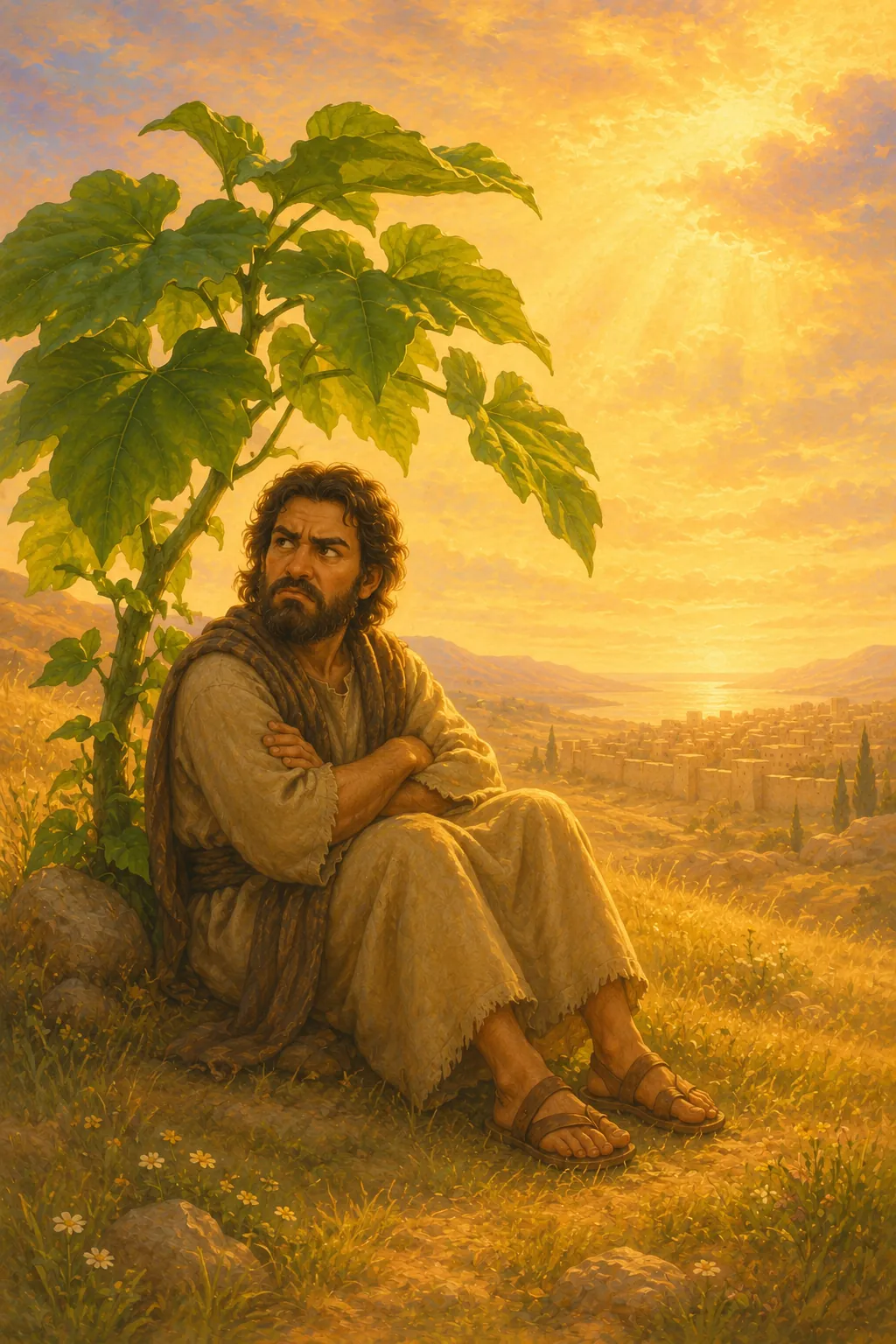
He did not want God to forgive those people. He stomped off, sat down on a hill outside the city, crossed his arms, and sulked. He was so cross that he grumbled to God, “I knew you would do this! I knew you were too kind and too forgiving!”

Now, how do you think God treated Jonah, who was sitting there sulking and angry?

God was gentle with him. God did not shout. God simply asked him a kind question: “Is it right for you to be so angry, Jonah?”

Then God made a leafy plant grow up over Jonah to give him cool shade, and Jonah was glad of it. But the next day the plant withered and died, and the hot sun beat down, and Jonah got angry all over again — this time about the plant!

So God taught Jonah gently, the way a patient, loving parent teaches a grumpy child. “Jonah,” God said, “you care so much about this one little plant. Shouldn’t I care about a whole city full of people that I made and love?”

All through Jonah’s sulking and grumbling and anger, God never stopped being patient. God never stopped loving him. God stayed close to Jonah and kept talking with him kindly — even when Jonah was being difficult and cross. God did not give up on him. He saw past the grumpiness to the hurting heart underneath, and He stayed right there beside him.

Jonah Is Angry with God

What This Means for Me

Have you ever felt angry — really angry — and maybe even angry at God? When someone you love is sick, you might feel cross that it is happening. You might feel cross that God has not made it better. And then you might feel bad or scared for feeling that way.

Here is what Jonah’s story gently tells you: God does not stop loving you when you are angry. Not even when you are angry at Him.

God was so patient with grumpy, sulking Jonah. He did not shout. He did not give up on him. He stayed close and kept talking with him, kindly and gently. God is exactly that patient with you, too. Your angry feelings do not scare Him away or make Him love you less.

So you do not have to hide your anger from God or pretend it is not there. The best thing you can do with an angry feeling is to bring it to God and talk to Him about it — just like Jonah did, sitting on his hill. God can handle your anger. And He will be patient and gentle with you, every time.

God is patient and gentle with us, even when we are cross with Him.
Memory Verse
“You are a gracious God, and merciful, slow to anger.”
Jonah 4:2 (WEB)
Prayer

Dear God,

Sometimes I feel angry, and sometimes I even feel angry at you.

Thank you that you do not stop loving me when I am cross.

Thank you that you are patient and gentle, just like you were with Jonah.

Help me to bring my angry feelings to you, instead of hiding them. Amen.

It’s Okay to Say How You Feel

Psalm 13 & Psalm 42

Did you know that the Bible has a whole book full of songs and poems? It is called the Psalms. And these are not all happy, cheerful songs. Many of them are honest songs about big, hard feelings — sadness, loneliness, fear, and even anger.

The people who wrote the Psalms told God exactly how they felt. They did not use polite, tidy words. They poured out their real hearts.

In one psalm, a man named David was feeling forgotten and sad. And do you know what he said to God? He said, “How long, O Lord? Will you forget me forever? How long must I feel this sorrow in my heart?” David said that straight to God! He was not being naughty. He was being honest.

In another psalm, the writer was so sad that he said, “My tears have been my food day and night.” That means he was crying so much it was as if his tears were all he could eat. He felt low and downhearted, and he told God all about it. He did not wait until he felt better to talk to God. He talked to God right in the middle of his sadness, while the tears were still falling.

Now here is the most beautiful part of all. God put these sad, honest songs right into the Bible — on purpose.

Why would God do that? He did it so that you would know, for certain, that it is okay to feel that way, and it is okay to tell Him. God is not waiting for you to be cheerful before you talk to Him. He wants your real heart — sad bits, angry bits, scared bits, and all.

And notice something else. These honest songs often start out sad, but as the writer keeps talking to God, something slowly changes. By the end, hope begins to peek through. David finished his sad song by saying, “But I trust in your loving kindness; my heart will be glad.” The other writer told himself, “Put your hope in God.”

Telling God exactly how you feel is not the end of hope. It is the very first step toward finding it again.

It’s Okay to Say How You Feel

What This Means for Me

When someone you love is sick, your heart can be full of all sorts of feelings at once — sad, scared, worried, angry, lonely. Sometimes those feelings are so big you might not even have words for them. And sometimes you might think you have to act happy, or be brave, or hide what is really going on inside.

But the Psalms show you a wonderful secret: you can tell God exactly how you feel. All of it. The happy feelings and the sad ones. The peaceful feelings and the angry ones. You do not have to dress them up or make them sound nice first.

God already knows what is in your heart, and He loves you completely. When you tell Him how you really feel, you are not pushing Him away — you are letting Him come close. And little by little, as you pour your heart out to the God who loves you, you may find that hope begins to peek through, just like it did in the Psalms.

We can tell God exactly how we feel — the sad parts and the angry parts too.
Memory Verse
“Pour out your heart before him.”
Psalm 62:8 (WEB)
Prayer

Dear God,

Thank you that I can tell you exactly how I feel.

When I am happy, I can tell you. When I am sad or scared or angry, I can tell you that too.

Thank you that you always listen, and you never stop loving me.

Right now, I want to tell you how I am really feeling… (you can tell him). Thank you for listening. Amen.

Five
Section
Part Five

When God Doesn't Answer the Way We Hope

15Job Loses Everything — and Meets God
16Paul’s Thorn
17Jesus Prays in the Garden

Job Loses Everything — and Meets God

Job 1–2; 38–42

Job was a good man. He loved God with his whole heart, and he tried his best to do what was right. He had a big, happy family and many good things, and life was full and bright.

Then, in a very short time, everything changed. Job lost almost all that he had. His animals were gone. His riches were gone. And, most heartbreaking of all, a terrible storm took the lives of his beloved children. Soon after, Job became sick and sore all over his body.

Job had not done anything wrong. He was a good man. And yet all of this happened to him. He was so sad that he sat down in the dust and wept and wept.

Job’s friends came to sit with him. At first that was kind. But then they started trying to explain it all. “You must have done something bad, Job,” they said, “or this wouldn’t be happening.” But they were wrong. That was not it at all.

Job did not have the answers either. He had only questions — big, aching ones. “Why?” he cried out to God. “Why has this happened to me?” Job was honest with God about his pain and his confusion. But notice this: even when he was hurting and angry, Job never stopped talking to God. He kept bringing it all to him.

Then, at last, God spoke to Job.

God did not hand Job a tidy list of reasons. Instead, God showed Job how great and wise He is. “Job,” said God, “where were you when I made the earth? Who hung the stars in the sky? Who fills the sea, and feeds the wild animals, and tells the morning when to come?”

God was gently saying: I am God. I am taking care of the whole, enormous world — things far too big for you to see or understand. There is so much you cannot know. But you can trust the One who does.

And something settled in Job’s heart. He still did not know why it had all happened. But he said to God, “Now my eyes have seen you.” Job knew that God was still God — still wise, still good, still holding the whole world. And even without the answers, that was something he could hold on to.

Job Loses Everything — and Meets God

What This Means for Me

This is one of the hardest, most honest stories in the whole Bible — and it tells us a true thing that grown-ups do not always say out loud: sometimes bad things happen to good people. Job did nothing to deserve what happened to him. Sometimes, sickness and sadness come, and it is not anyone’s fault, and it is not a punishment from God.

When something hard happens to you or your family, you might ask “Why?” over and over. Job did too. And here is the honest truth: we do not always get to know why. Job never found out the reason.

But look at what Job did find. He found that even without the answers, God was still God — still wise, still good, still taking care of the world, still close to him. You may not understand why hard things happen. That is okay. You are allowed to ask, and allowed to be sad. And even with all your questions, you can hold on to this: God is still God, and He still loves you. That is something steady to stand on, even when nothing else makes sense.

Bad things can happen to good people; we may not understand, but God is still God.
Memory Verse
“I know that you can do all things.”
Job 42:2 (WEB)
Prayer

Dear God,

Sometimes bad things happen, even to good people, and I do not understand why.

Thank you that I can be honest with you about my sad and confused feelings.

Even when I do not understand, help me to remember that you are still God — still wise, still good.

I will trust you. Amen.

Paul’s Thorn

2 Corinthians 12:7–10

Paul loved God very much. He travelled to faraway places — over land and across the sea — telling everyone he met the good news about Jesus. Paul was brave and strong in his faith.

But Paul had a problem. Something hurt him and bothered him, something that would not go away. Paul called it “a thorn in my flesh.” We are not quite sure what it was — perhaps a sickness, or a pain, or something that made his life hard every day. But we do know it troubled him a great deal.

So Paul did what you and I would do. He prayed. He asked God to take it away.

He prayed once: “Please, God, take this away.” It did not go away. He prayed a second time: “Please, God, take this away.” Still it stayed. He prayed a third time, asking God with all his heart to please, please remove this hard thing.

But God did not take it away.

Instead, God gave Paul something else. God gave him a promise. God said, “My grace is enough for you. My power works best when you are weak.”

God was saying: I am not going to remove this hard thing from your life. But I am going to do something else. I am going to give you my own strength to carry it — strength for today, and then fresh strength again tomorrow, and again the day after that.

And Paul discovered something surprising. When he felt weak and small, that was exactly when he felt God holding him up the most. The hard thing did not disappear — but God’s strength was always there, like a strong arm around him that never let go. On the days Paul felt he could not take one more step, he found God’s strength was already there, carrying him. It was not Paul’s own strength at all — it was God’s, given fresh each morning.

So Paul stopped being upset about it. He even said he was content, because he had learned that God’s strength was made perfect in his weakness. The thorn stayed — but so did God, every single day.

Paul’s Thorn
Paul’s Thorn

What This Means for Me

Sometimes we pray and pray for God to take a hard thing away — a sickness, a sadness, a worry — and it does not go away. That can be one of the most confusing and painful things of all. You might wonder, “Did God even hear me? Why didn’t He fix it?”

Paul felt exactly that. He asked three times, and the answer was still no. But his story shows us that “no” was not the end of God’s answer. There was a second part.

Sometimes, instead of taking the hard thing away, God gives us the strength to carry it. Not strength for the whole journey all at once — just enough for today. And then, tomorrow, He gives us more. You might not feel strong at all. That is okay — in fact, God’s strength works best in us exactly when we feel weak and small.

God does not always take the mountain away. But He always helps us climb it, one step at a time, and He never lets go of our hand. His help is enough. His grace is enough. And He will never, ever leave you to carry your hard thing alone.

Sometimes God gives us strength to carry something instead of taking it away.
Memory Verse
“My grace is sufficient for you.”
2 Corinthians 12:9 (WEB)
Prayer

Dear God,

Sometimes I ask you to take a hard thing away, and it is still here. That is hard.

Thank you that even when you do not take it away, you give me strength to carry it.

Please give me your strength, just enough for today.

Thank you that your help is always enough. Amen.

Jesus Prays in the Garden

Matthew 26:36–46

On the night before Jesus died, He went with His friends to a quiet garden full of olive trees. It was called Gethsemane. Jesus had gone there to pray.

Jesus knew that something very hard and very painful was coming the next day. And even though Jesus is God’s own Son, in that moment He felt deeply sad and troubled. He told His closest friends, “My heart is so full of sorrow.” Then He asked them to stay near while He went a little further on, by Himself, to pray. The garden was dark and quiet, and the night air was cool. Jesus’ friends were so tired that their eyes kept closing, and one by one they fell asleep — so Jesus prayed alone, with only His Father to hear Him.

Jesus knelt down on the ground. And here is something very important for us to notice.

Jesus — who loved His Father perfectly and trusted Him completely — asked God if there might be another way. He prayed, “My Father, if it is possible, please take this cup of suffering away from me. I do not want this.”

Did you hear that? Jesus asked for the hard thing to be different. He told His Father exactly what He wanted, honestly and from the heart. And it was not wrong for Him to ask. It was not a lack of faith. It was Jesus, being real with His Father.

But then Jesus prayed something else, too. He said, “Yet not what I want — what you want, Father. I trust you.”

Jesus brought His honest, scared, sorrowful feelings to God. And then He placed the whole thing into His Father’s hands and trusted Him with the answer — even though the answer was still going to be a hard one.

God gave Jesus the strength He needed to face what was ahead. And because Jesus trusted His Father through the very hardest thing, He opened the way for you and me to be close to God forever. Jesus understands hard prayers, because He prayed one Himself, in a quiet garden, in the dark.

Jesus Prays in the Garden

What This Means for Me

When something really hard is coming — or is already here — it is completely okay to ask God to change it. You can pray, “God, please make this better. Please take this away. Please make my loved one well.” That is a good and right prayer. We know it is, because Jesus Himself prayed exactly that kind of prayer.

Jesus asked His Father for a different way. So you are allowed to ask too. You never have to pretend you are fine, or hide what your heart truly wants.

But Jesus also showed us a second part of the prayer: “…and I trust you with the answer.” Sometimes God’s answer is still a hard one, like it was for Jesus that night. Yet we can trust that God is good, that He is right there with us in the hard thing, and that He is able to bring something beautiful even out of the very hardest times.

So tell God what you long for, with all your heart. Ask Him boldly. And then, like Jesus, you can gently place it in His hands and say, “I trust you.” He loves you, and He will never let go.

Even Jesus asked for a different way — it is okay to ask, and to trust God with the answer.
Memory Verse
“Not what I desire, but what you desire.”
Matthew 26:39 (WEB)
Prayer

Dear Jesus,

Thank you that even you asked God for a different way when things were hard.

That means I can ask too. So I ask you now: please help with the hard thing in my life.

And, like you, I want to say: I trust you.

Thank you that you are always with me. Amen.

Six
Section
Part Six

When We Feel Sad

18Hannah Prays Through Her Tears
19Elijah Under the Broom Tree
20Jesus Weeps for His Friend
21The Father Runs to His Son

Hannah Prays Through Her Tears

1 Samuel 1

Hannah carried a deep, quiet sadness in her heart. More than anything in the world, she longed to have a baby — and year after year went by, and there was no baby. The sadness did not go away. Sometimes it hurt so much that Hannah could not even eat.

The people around her did not really understand. Even her husband, who loved her, did not know what to say. “Aren’t I enough for you?” he asked. But that did not make the ache in Hannah’s heart any smaller.

One day, Hannah went to God’s house to pray. She was so full of sorrow that the tears poured down her face. She prayed and prayed, pouring out all the sadness inside her to God. Her lips were moving, but she was crying too hard to make any sound. She did not hold anything back. She told God about the long years of waiting, and the ache that would not go away, and how tired her heart had become. She let it all spill out before Him.

The old priest, Eli, was watching. And do you know what? He got it completely wrong. He thought Hannah was behaving strangely. He even thought she had been drinking too much! “How long are you going to act like this?” he said.

But Hannah explained gently. “No, sir. I have not been drinking. I am just a woman with a very sad heart, and I am pouring out my soul to God.”

Eli’s face softened. “Then go in peace,” he said, “and may God give you what you have asked.”

And here is the beautiful part. Hannah got up — and her face was not sad anymore. Nothing about her problem had changed yet. But she had given all her sorrow to God, and she knew, deep down, that He had heard her.

Even when not one person around her understood her tears, God understood every single one. And in time, God gave Hannah the desire of her heart — a baby boy named Samuel, who grew up to love and serve God all his life.

Hannah Prays Through Her Tears

What This Means for Me

When you are very sad and the tears come, sometimes it feels like nobody understands. Grown-ups are busy. People say the wrong thing, just like Eli did at first. You might feel completely alone in your crying.

But Hannah’s story tells you something wonderful: God understands every tear. He does not think your crying is silly, or babyish, or wrong. When you cry, God leans in close and listens. The Bible even says He keeps your tears like something precious to Him.

So when you are sad — when someone you love is sick, or things feel too heavy — you can do exactly what Hannah did. You can pour out your whole heart to God, tears and all. You do not have to use fancy words or stop crying first. And even if nothing about your problem has changed yet, you can know, like Hannah did, that the God who loves you has heard every word and caught every tear.

God listens when we cry, even when no one else understands.
Memory Verse
“You put my tears into your bottle.”
Psalm 56:8 (WEB)
Prayer

Dear God,

Sometimes I am so sad that I cry, and I feel like no one understands.

Thank you that you understand every tear.

Thank you that I can pour out my whole heart to you.

Thank you that you are always listening, and you never think my tears are silly. Amen.

Elijah Under the Broom Tree

1 Kings 19

Elijah was a brave prophet of God. He had just done a great and mighty thing for God in front of everyone. You might think he would feel wonderful afterward. But instead, Elijah felt completely worn out.

He was tired in his body and tired in his heart. He was frightened, and discouraged, and he felt all alone. He ran far away into the wilderness, sat down under a little bush called a broom tree, and said, “I have had enough, God. I just want to give up.”

Then, exhausted, Elijah lay down and fell fast asleep. He had run so far, and worried so much, that there was nothing left in him at all. His arms felt heavy. His eyes would not stay open. He just wanted everything to stop.

Now, how do you think God treated his tired, discouraged prophet? Did God scold him? Did God say, “Get up and try harder”? No. God was wonderfully gentle.

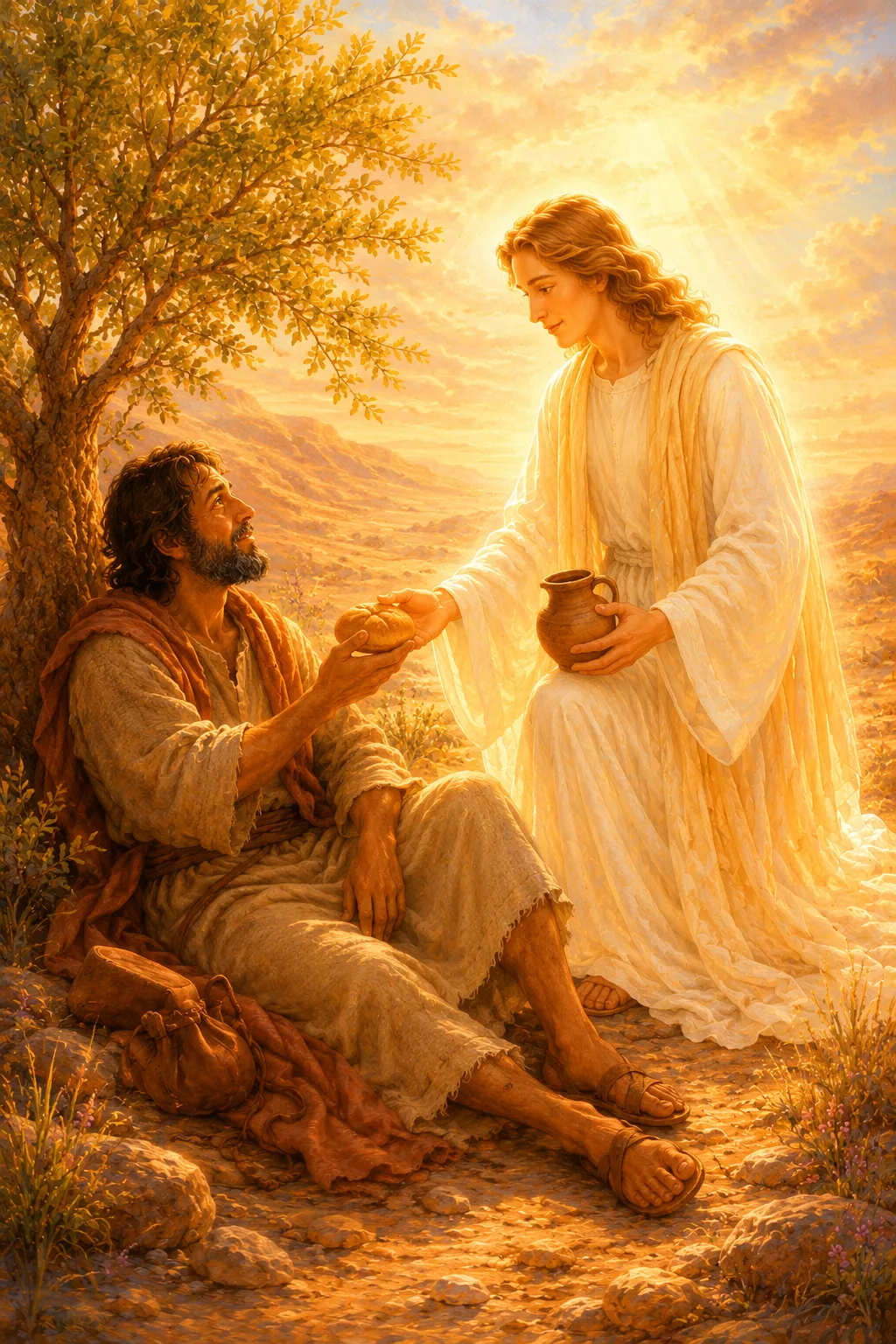
God sent an angel. The angel touched Elijah softly and said, “Get up and eat.” And there, right beside him, was warm bread to eat and a jar of cool water to drink. Elijah ate a little, drank a little, and lay down to sleep again.

Then the angel came a second time, touched him gently once more, and said, “Get up and eat some more. The journey is too much for you.” God knew Elijah was weary, so He gave him food, and water, and rest.

And later, God came to meet Elijah. But God did not come in a roaring wind, or a shaking earthquake, or a blazing fire. God came in a soft, gentle whisper. Kindly, God asked, “What is the matter, Elijah?” And God reminded him that he was not alone after all. “You feel like the only one left,” God told him gently, “but you are not. I am with you, and there are others who love me too.” Bit by bit, Elijah’s heart began to feel a little less heavy.

God cared for every part of Elijah — his tired body, and his discouraged heart.

Elijah Under the Broom Tree

What This Means for Me

Did you know that being sad can make you very, very tired? When someone you love is sick, you can get worn out all the way down to your bones — tired of being brave, tired of worrying, tired of big feelings. Sometimes you might feel just like Elijah: “I have had enough.”

If that is how you feel, this story is gentle good news for you. God did not tell Elijah to cheer up or try harder. Instead, God gave him food, water, sleep, and a soft, kind whisper. God was tender with him.

God is just that tender with you, too. He understands when you are worn out and discouraged. He is not cross with you for feeling tired. Sometimes the most faithful, sensible thing you can do is rest — to eat something, to sleep, to be quiet, and to let God take care of you for a while. You do not have to be strong every moment. God is gentle with tired and discouraged people, and that includes you.

God cares tenderly for people who are tired and discouraged.
Memory Verse
“Come to me… and I will give you rest.”
Matthew 11:28 (WEB)
Prayer

Dear God,

Sometimes I feel so tired and discouraged, like Elijah under the tree.

Thank you that you are gentle with me when I am worn out.

Thank you that you give rest to tired hearts.

Help me to rest in you, and to remember that I am not alone. Amen.

Jesus Weeps for His Friend

John 11:35

Jesus had a very dear friend named Lazarus, and two friends who were Lazarus’s sisters — Mary and Martha. The three of them were like family to Jesus. He loved them, and they loved Him.

One day, sad news reached Jesus: Lazarus had become very sick. And before Jesus arrived, Lazarus died. By the time Jesus came to the little town of Bethany, the whole family and all their friends were full of deep sorrow. There was weeping everywhere.

Martha came out to meet Jesus first, her eyes red from crying. “Lord,” she said, “if you had been here, my brother would not have died.” Her heart was breaking. Jesus spoke to her gently and full of hope — but the sadness in that little town was very deep, and all around, people were weeping.

Mary came to Jesus, crying. “Lord,” she said through her tears, “if only you had been here.” And all around her, people were weeping too.

Then something beautiful and surprising happened. Jesus — the strong and mighty Son of God — looked at Mary crying, and looked at all the sad faces around Him, and His own heart was deeply moved.

And Jesus cried.

The very shortest verse in the whole Bible tells us so, in just two simple words: “Jesus wept.”

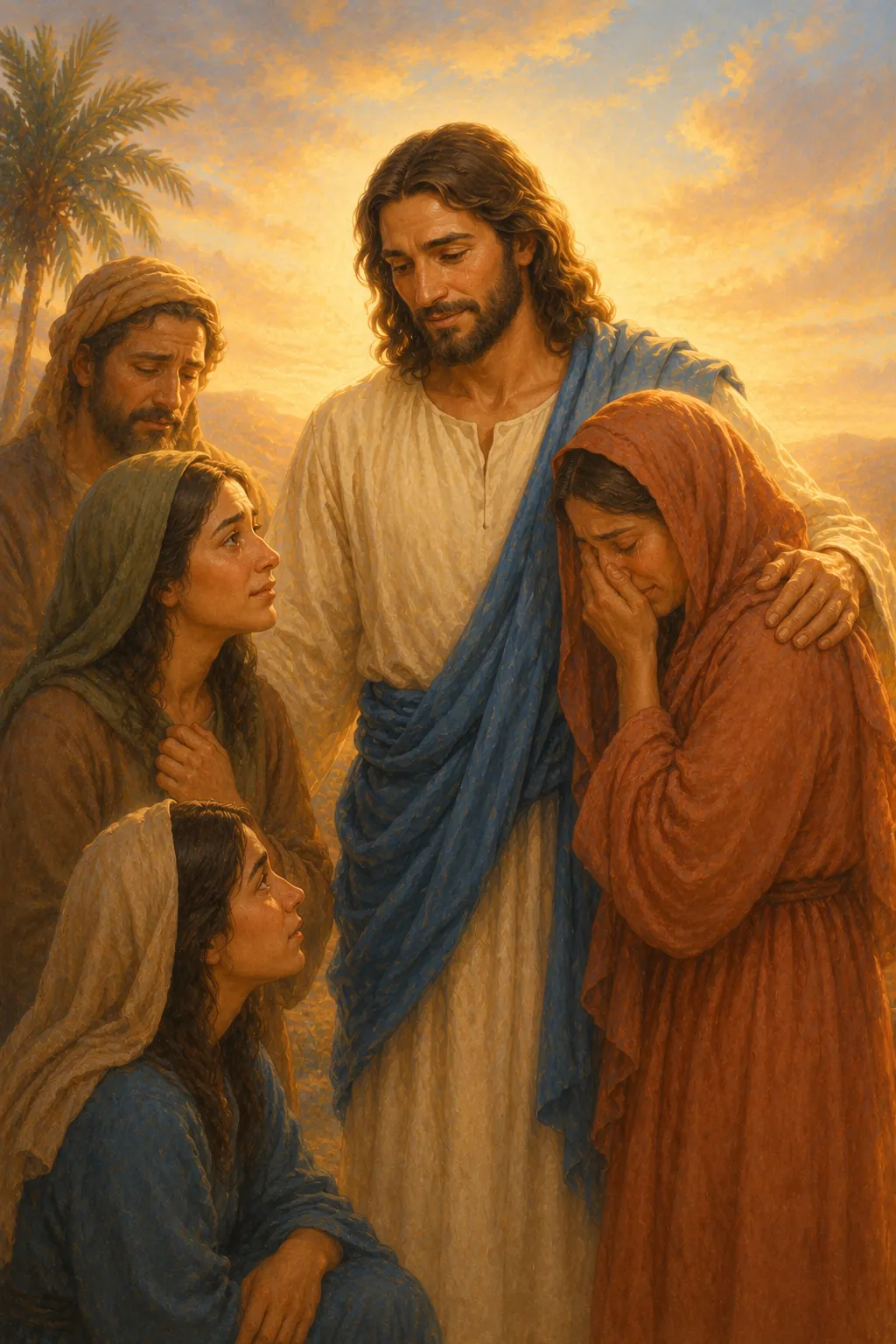
He stood there with His grieving friends and wept real tears, because He loved Lazarus, and because it hurt Him to see the people He loved in so much pain. The people who saw Him said to one another, “See how much He loved Lazarus.” His tears were not weak at all. They were full of love. They showed everyone just how much Jesus cared.

Now, Jesus knew that He was about to do something wonderful — in just a few moments, He would call Lazarus right out of the grave, alive again! And yet, even knowing that, Jesus did not rush past the sadness. He did not say, “Stop crying.” First, He stood with His hurting friends, and He cried with them. That is the kind of friend Jesus is — one who weeps with us first, before He wipes the tears away.

Jesus Weeps for His Friend

What This Means for Me

Have you ever been told, “Don’t cry,” or “Be strong,” or “Big kids don’t cry”? Lots of children hear things like that. But look closely at this story, because it shows us something very important.

Jesus cried. The strongest, kindest, most loving person who ever lived stood beside His friend’s grave and wept real tears. That means your tears are not wrong. They are not weak or babyish. Crying is not something to be ashamed of — Jesus Himself did it.

So when you are sad, when you miss someone, when your heart aches — Jesus understands completely, because He has felt it too. He does not stand far away from your sadness, waiting for you to cheer up. He comes close, and He is willing to cry right alongside you. You never have to hide your tears from Jesus. He knows exactly how they feel, and He meets you in them with love.

Jesus understands grief — He cried too.
Memory Verse
“Jesus wept.”
John 11:35 (WEB)
Prayer

Dear Jesus,

Thank you that you cried real tears when your friend died.

Thank you that my tears are okay, and that you understand them.

When I am sad, thank you that you come close and stay with me.

Thank you that I never have to cry alone. Amen.

The Father Runs to His Son

Luke 15:11–32

One day Jesus told a story to help people understand how much God loves them. It was about a father and his younger son.

The younger son grew restless. “Father,” he said, “give me my share of everything now.” So the father did. And the son packed up and travelled far, far away, and there he wasted all his money on foolish things, until he had nothing left at all.

Then hard times came, and the son grew hungry. He ended up in a field, feeding pigs, so hungry that even the pigs’ food looked good to him. He had never felt so low or so far from home.

Then he thought of his father. “Even the servants in my father’s house have plenty to eat,” he said. “I will go home, and say I am sorry, and ask to be one of his servants.” So he began the long, slow walk home, practising his sorry speech, certain his father would be angry with him. Every step of that long road, he worried. Would his father even let him in? Would he be shouted at, or turned away? He felt so ashamed of all he had done. He did not feel like a son anymore — just someone hoping to be a servant.

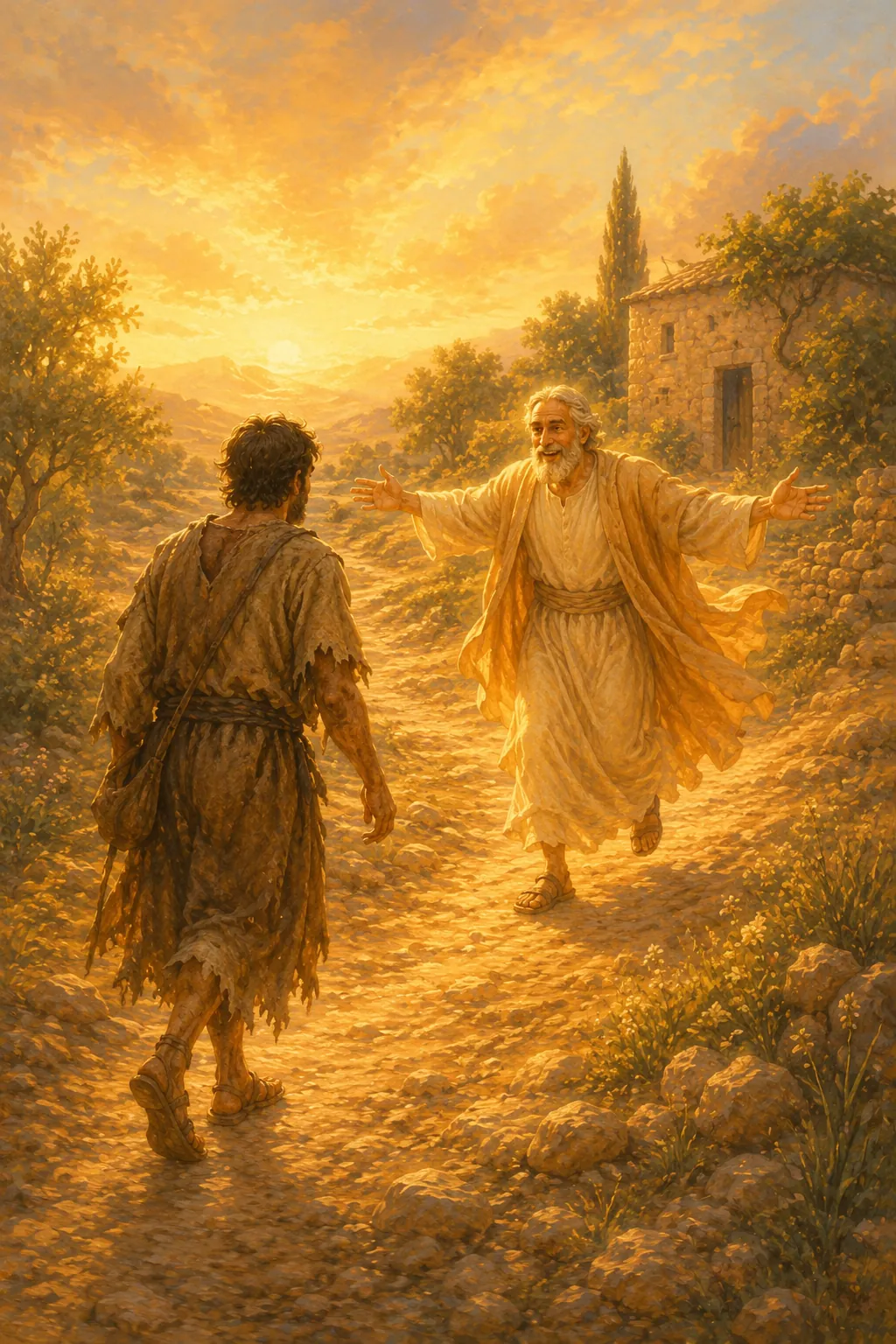
But while the son was still a long way off — so far down the road that you could barely see his face — the father saw him coming. The father had been watching that road, hoping, every single day.

And then the father did something that grand old men simply did not do. He ran. He gathered up his robe and ran down the road as fast as he could, threw his arms around his dusty, ragged son, and kissed him.

The son began his sorry speech, but the father was already calling out with joy, “Quick! Bring the best robe! Let’s have a feast! My son was lost, and now he is found!”

The father had never stopped loving him. He had never stopped watching the road. He had never, ever given up.

The Father Runs to His Son

What This Means for Me

Jesus told this story to show us what God is like. God is like that father.

No matter what happens, no matter how far away you feel, no matter what you have done or how badly you think you have messed up — God is watching the road for you, with love. And the very moment you turn back toward Him, He comes running. He does not fold His arms and wait for you to grovel. He runs to wrap you up in a great big hug.

When someone you love is sick, there might be days when you feel far from God — angry, or confused, or like you have drifted away from Him. That is okay. It does not change His love for you one tiny bit. God’s love never gives up on you, and it never lets you go. He is always, always running toward you with His arms wide open, so glad to have you near.

God’s love never gives up on us and never lets us go.
Memory Verse
“I have loved you with an everlasting love.”
Jeremiah 31:3 (WEB)
Prayer

Dear God,

Thank you that you love me like the father in the story.

Thank you that even when I feel far away, you are watching the road for me.

Thank you that you come running to me with open arms.

Thank you that your love never, ever gives up on me. Amen.

Seven
Section
Part Seven

The Power of Prayer

22Jehoshaphat’s Impossible Day
23Paul and Silas Sing in Prison
24The Church Prays for Peter

Jehoshaphat’s Impossible Day

2 Chronicles 20

King Jehoshaphat woke up one day to terrible news. Three huge armies were marching toward his land to attack his people. His own army was small. There were far, far too many enemies. It was an impossible day.

The king was afraid — truly afraid. But Jehoshaphat was wise, and here is the wise thing he did: the very first thing, before anything else, he turned to God. He could have called for more soldiers. He could have run away and hidden. He could have sat and worried himself sick. But he did none of those things first.

He did not panic. He did not pretend he was not scared. He did not rush off to fight on his own. Instead, he gathered all the people together — mums and dads and little children, everyone — and he prayed out loud, honestly, for them all to hear.

“God,” he prayed, “we are afraid. This enemy is far too big for us. We do not know what to do.” And then he said the most important words of all: “But our eyes are on you.”

And God answered. A message came from God through one of His helpers: “Do not be afraid. Do not be discouraged. This battle is not yours — it is God’s. Tomorrow, just go out and stand still, and watch what I will do for you.”

The next morning, the people went out to face the enemy. But they did not even have to fight! When they arrived, they found that God had already taken care of the three armies completely. In fact, Jehoshaphat had sent singers out in front of the army, singing praises to God before anything had even happened — that is how much they trusted Him. And God did not let them down. The enemy was gone, and not one of God’s people was harmed.

The people who had no idea what to do, but who turned to God first, were saved. And do you know how they went home? Singing and full of joy.

Jehoshaphat’s Impossible Day

What This Means for Me

Sometimes a problem is just too big, and you truly have no idea what to do. When someone you love is very sick, that is exactly how it feels — too big, no answers, and nothing you can do to make it better. It can leave you feeling helpless and scared.

King Jehoshaphat shows us the very wisest first move: turn to God first. Not as a last resort, after you have tried everything else and nothing worked — but first, right at the start.

You can pray the most honest prayer there is: “God, I do not know what to do, but my eyes are on you.” That is a wonderful prayer. You do not need a clever plan. You do not have to be strong or brave. You simply turn your eyes toward God and ask Him to help. Turning to God first, when life feels too big, is never, ever the wrong thing to do. He loves it when we look to Him.

When we don’t know what to do, we can turn to God first.
Memory Verse
“We don’t know what to do, but our eyes are on you.”
2 Chronicles 20:12 (WEB)
Prayer

Dear God,

Sometimes my problems feel way too big, and I do not know what to do.

Thank you that I can turn to you first.

I do not have all the answers, but I am looking to you.

Please help me, and help the people I love. My eyes are on you. Amen.

Paul and Silas Sing in Prison

Acts 16:16–34

Paul and Silas loved God and travelled from place to place, telling people the good news about Jesus. But one day, for doing good, they got into trouble. They were arrested and thrown into prison.

It was not a nice prison. They were put in the deepest, darkest cell, with their feet locked in heavy chains. And it was the middle of the night. It was just about the hardest, gloomiest place you could imagine being. Their backs were sore. Their feet could not move. There were no soft beds, no friends, and no light — just cold stone and darkness. Anyone would have felt like giving up in a place like that.

So what do you think Paul and Silas did? You might expect them to cry, or to grumble, or to give up hope.

But they did something amazing instead. They prayed. And then — they began to sing! Right there in the dark prison, with chains on their feet, Paul and Silas sang happy songs of praise to God. The other prisoners lay in their cells and listened in wonder. They had never heard anything like it. Paul and Silas did not sing because the prison was nice — it was not. They sang because they knew God was with them, even there, even then. Their songs floated through the dark, and slowly the saddest place was filled with the sound of praise.

And then, suddenly — the ground began to shake! A great earthquake rumbled through the prison. The doors flew wide open, and everyone’s chains simply fell off!

The jailer woke up terrified, but Paul called out kindly, “We are all still here. Don’t be afraid!” The jailer could hardly believe it. That very night, he and his whole family came to believe in Jesus, and there was great joy in that prison. The man who had locked them up now became their friend. He gently washed their sore backs and brought them food, and his whole house was filled with happiness.

Paul and Silas had brought light into the darkest place of all — simply by praying and singing to God.

Paul and Silas Sing in Prison

What This Means for Me

Some places and some times are really hard and dark — a hospital in the middle of the night, a scary waiting room, a lonely bedroom when you cannot fall asleep for worrying. In a place like that, it might feel like the wrong moment to pray, or like there is nothing in the world to sing about.

But Paul and Silas teach us that we can pray — and even sing — in the very hardest places. We do not pray only when everything is going well. We pray because God is with us even when things are not going well at all.

Singing a little song to God in a hard moment does not mean you are pretending everything is fine. It means you are remembering that God is right there with you, even in the dark. And here is a lovely thing: sometimes a quiet prayer or a soft song in a dark place is the very first little bit of light to shine. You can always talk to God, and you can always sing to Him — wherever you are, however hard it is.

We can pray — and even sing — in the hardest places.
Memory Verse
“In the night his song shall be with me.”
Psalm 42:8 (WEB)
Prayer

Dear God,

Thank you that Paul and Silas could sing to you, even in a dark prison.

Thank you that I can pray and sing to you in hard and scary places too.

When the night feels long, help me to remember that you are right here with me.

Be my song in the dark. Amen.

The Church Prays for Peter

Acts 12:1–17

Peter was one of Jesus’ closest friends and a leader of the very first church. But a cruel king did not like the church, and he had Peter arrested and thrown into prison.

It looked completely hopeless. Peter was locked deep inside the prison, guarded by soldiers, with chains on his wrists, sleeping between two guards. There was no way out. There were guards at the door, and guards in the hallway, and a great iron gate at the front. Even Peter’s closest friends could not reach him. From the outside, it seemed there was nothing at all that anyone could do to help him.

But the people who loved Peter — his church family — did the most powerful thing they could possibly do. They gathered together in a house, and they prayed for him. They prayed and prayed, all through the night. They did not have swords, or keys, or clever plans. But they had something far stronger: they had God, and they had prayer. So they knelt together and asked God to help their dear friend Peter.

And that very night, while Peter lay sleeping in his chains, an angel of God suddenly appeared, and the dark cell filled with light. The angel gently woke Peter, and right away the chains fell off his wrists! “Quick, get up,” the angel said. “Follow me.”

Peter followed, hardly able to believe it was real. They walked right past the sleeping guards. They came to the great iron gate of the prison — and it swung open all by itself! Peter stepped out into the night, free.

He hurried to the house where everyone was praying, and he knocked at the door. A servant girl named Rhoda heard his voice, and she was so overjoyed that she forgot to even open the door — she just ran back inside to tell everyone! They could scarcely believe it. But there stood Peter at the door, free and safe. When at last they opened the door and saw him with their own eyes, they were filled with amazement and joy.

God had heard the prayers of the people who loved Peter.

The Church Prays for Peter

What This Means for Me

When someone we love is in trouble or very sick, we can feel like there is nothing we can do. We are not doctors. We are not in charge. We are often small, and the problem is big.

But this story shows us the most powerful thing any of us can do: pray for the people we love. Peter’s church family could not break him out of prison. But they could pray — and God heard them, and did what they never could have done themselves.

Your prayers for the people you love — your mum, your dad, your grandma, your friend — truly matter. They reach all the way to God. You may be young and small, but your prayers are never small to Him. Now, God does not always answer in the exact way we hope, as we have seen. But no prayer is ever wasted, and not one of them goes unheard. When you pray for someone you love, you are doing one of the most powerful and loving things in the whole world. So never think your prayers do not count. God hears every single one.

Praying for the people we love truly matters.
Memory Verse
“Pray for one another.”
James 5:16 (WEB)
Prayer

Dear God,

Thank you that you heard the prayers of the people who loved Peter.

Thank you that my prayers matter to you, even though I am small.

Tonight I want to pray for someone I love… (you can tell God their name).

Thank you that you hear every prayer. Amen.

Eight
Section
Part Eight

Family, Friends and Community

25Ruth Stays with Naomi
26Jonathan Encourages David
27The Good Samaritan

Ruth Stays with Naomi

Ruth 1–4

Naomi had moved with her family to a faraway land. But while they lived there, very sad things happened. First Naomi’s husband died, and then, after some years, her two grown sons died as well. Naomi was left with a broken heart and her two daughters-in-law, two younger women named Ruth and Orpah.

Naomi decided to go back home to her own town, Bethlehem. She turned to the two young women she loved and said, “You should stay here, in your own land, where you have families and a future. Go home, and may God be kind to you.” She kissed them goodbye, and they all wept together.

Orpah hugged Naomi and, crying, said goodbye. But Ruth would not let go. Ruth held onto Naomi and said some of the most beautiful words in the whole Bible.

“Don’t ask me to leave you,” said Ruth. “Where you go, I will go. Where you stay, I will stay. Your people will be my people, and your God will be my God. I am staying with you.”

So Ruth went with Naomi, even though it meant leaving behind everything she had ever known. The two of them walked the long, dusty road to Bethlehem together — two women who had known great sadness, but who now did not have to face it alone.

In Bethlehem, Ruth worked hard out in the fields, gathering grain so that she and Naomi would have food to eat. And all the while, God was quietly taking care of them both. Naomi watched how Ruth never grumbled and never gave up, and slowly a little hope began to creep back into her tired heart.

A kind and good man named Boaz noticed how faithful and loving Ruth was. In time, Ruth and Boaz were married. And Naomi — who had felt so empty and so sad — found that her life was full again. She even had a little grandson to hold in her arms.

God turned Naomi’s sadness into joy. And one of the ways He did it was through Ruth — a faithful friend who simply refused to let her walk through the hard times alone.

Ruth Stays with Naomi

What This Means for Me

When something hard happens in a family — like a serious illness — it can feel very lonely, even when there are people all around you. You can feel like no one really understands, and like you are carrying it all by yourself.

But God’s plan is that we do not have to face hard times alone. He gives us people. He gives us family, and friends, and kind neighbours, and people from church — people who say, just like Ruth, “I am staying with you.” When someone walks the hard road beside you, that is one of the very ways God wraps His love around you.

And here is something lovely: you can be a Ruth for someone else, too. You can stay close to a friend who is sad. You can choose not to leave someone all alone in their hard time. We were never meant to walk through the hard times by ourselves. God puts loving people beside us — and, best of all, He is right beside us too.

We do not have to face hard times alone.
Memory Verse
“Where you go, I will go.”
Ruth 1:16 (WEB)
Prayer

Dear God,

Thank you that I do not have to face hard times all by myself.

Thank you for the people who stay close to me and love me.

Help me to be a good friend, like Ruth, who stays beside others when they are sad.

Most of all, thank you that you are always with me. Amen.

Jonathan Encourages David

1 Samuel 23:15–18

David was in great danger. King Saul had grown jealous of him and was hunting for him, trying to do him harm. So David had to hide far away in the wilderness — among the rocks and caves, always looking over his shoulder.

David was tired. He was frightened. And he was discouraged, right down deep in his heart. He must have felt so terribly alone out there. Day after day he waited and hid. He did not know how long it would last, or whether the king would ever stop chasing him. His heart grew heavier and heavier.

But David had a true friend. His name was Jonathan, and — believe it or not — Jonathan was King Saul’s own son. Even though it was risky, even though his own father was the danger, Jonathan went out to find his friend David in his hiding place.

And do you know what Jonathan brought with him? He did not bring an army. He did not bring weapons. He brought something even better than those.

Jonathan helped David find his strength in God again.

He sat with his weary friend and reminded him of God’s promises. “Don’t be afraid,” Jonathan said gently. “God is with you. God has good plans for you, and they are going to come true. And you are not alone — I am your friend, and God is near.” Jonathan reminded David of all the times God had helped him before — from the lion and the bear to the giant Goliath. “The same God is with you now,” Jonathan said. “He has not forgotten you for even one moment.”

Those kind, true words were exactly what David needed. They gave him courage again. His problem had not gone away — King Saul was still out there, and David was still in the wilderness. But David’s heart was stronger now, because a good friend had pointed him back to God.

The two friends made a promise of friendship before God. Then Jonathan went home. And David, though still in a hard place, was no longer fighting his fear alone. One short visit from a faithful friend had changed everything — not the danger around him, but the courage inside him.

Jonathan Encourages David

What This Means for Me

When you are going through a hard time, a good friend is one of God’s very best gifts. And here is something important: a good friend does not have to fix your problem to help you. Often, the best thing a friend can do is simply be there — and remind you that God is with you, just like Jonathan did for David.

When someone you love is sick, look around for the friends God has given you — people you can talk to, people who remind you that you are not alone and that God is near. Let them sit with you. Let them help carry your heavy feelings.

And you can be that kind of friend, too. When a friend of yours is sad or scared, you can sit beside them, be kind, and gently remind them that God loves them and is with them. You do not need to have clever answers. A good friend helps us find our strength in God again — and that is one of the most loving things anyone can ever do.

A good friend helps us find our strength in God again.
Memory Verse
“A friend loves at all times.”
Proverbs 17:17 (WEB)
Prayer

Dear God,

Thank you for friends who help me feel braver, like Jonathan helped David.

Thank you that a good friend can remind me that you are near.

Please help me to be that kind of friend to others.

Thank you that you are the best friend of all. Amen.

The Good Samaritan

Luke 10:25–37

One day Jesus told a story to show people what real love looks like.

A man was travelling alone down a long, lonely road. On the way, robbers attacked him. They hurt him, took everything he had, and left him lying by the side of the road, unable to get up. He needed help badly. He could not stand up. He could not call out very loudly. All he could do was lie there and hope that someone — anyone — would stop and care.

Soon, a religious man came walking down that same road. He saw the hurt man lying there. But then he crossed over to the other side and walked straight past, as if he had not seen him at all.

A little later, another important man came along. He, too, looked at the hurt man — and he also passed by on the other side. How sad that must have felt, to be hurt and to watch people walk right by.

But then a third man came down the road. He was a Samaritan — someone the hurt man’s people usually looked down on and did not like. You might expect him to pass by as well.

Instead, when the Samaritan saw the hurt man, his heart filled up with kindness. He stopped. He knelt down beside him. Gently, he cleaned and bandaged the man’s wounds. He did not hurry, and he did not worry about getting his own clothes dirty or about how much time it would take, or about the fact that this hurt man was a stranger. He lifted him carefully onto his own donkey and brought him to an inn, where he looked after him through the night. The next day, he even paid the innkeeper to keep caring for the man until he was well again.

Then Jesus asked a question. “Which of these three men was a real neighbour to the one who was hurt?”

The answer was easy. It was not the two important men who had walked by. It was the one who stopped and showed kindness. And Jesus said, gently and clearly, “Go, and do the same.”

The Good Samaritan
The Good Samaritan

What This Means for Me

Most of this book is about times when you are the one who needs comfort. But this story shows us something else that is wonderful and true: you can also be the helper.

When someone around you is hurting — a friend whose family is going through a hard time, a classmate who is sad, a child who is being left out — you can be like the kind Samaritan. You do not have to do something big. You can do small, kind things: sit with them, share with them, say a gentle word, include them, or simply notice them when others do not.

Here is a beautiful secret: when you have known sadness yourself, you often understand other people’s sadness better. That makes you an extra-kind helper. When you care for someone who is hurting, you are doing exactly what Jesus said — “Go, and do the same” — and you are showing them God’s love with your very own hands.

We can be the helpers — caring for people who are hurting.
Memory Verse
“Be kind to one another.”
Ephesians 4:32 (WEB)
Prayer

Dear God,

Thank you for the kind Samaritan who stopped to help.

Help me to notice people who are hurting or left out.

Help me to be a helper, with kind words and kind hands.

Thank you that when I show love to others, I am showing them you. Amen.

Nine
Section
Part Nine

Hope Beyond Death

28Lazarus Comes Out
29The Man Beside Jesus
30The Saddest Day and the Brightest Morning
31God Makes Everything New

Lazarus Comes Out

John 11

Do you remember Jesus’ dear friend Lazarus, and his sisters Mary and Martha? Lazarus had become very sick, and he had died. Jesus had come to be with the family, and He had wept real tears with them, because He loved them so. Mary and Martha were heartbroken. Their home, which used to be full of laughter, now felt empty and quiet and sad.

But Jesus knew that this sad day was not the end of the story.

Jesus walked to the place where Lazarus had been laid to rest — a tomb in a quiet garden, with a big stone rolled across the doorway. Jesus said, “Take away the stone.”

Martha was unsure. “But, Lord,” she said, “Lazarus has been gone four days now.” Jesus looked at her with such kindness. “Did I not tell you,” He said gently, “that if you believe, you will see the glory of God?” So Martha trusted Him, even though she did not understand. A small crowd had gathered, and everyone grew very quiet, wondering what Jesus was about to do.

So they rolled the heavy stone away. Jesus lifted His eyes to heaven and thanked His Father. And then, in a strong, clear voice that everyone could hear, Jesus called out:

“Lazarus! Come out!”

His voice rang out across the garden, strong and full of love. For a moment, everything was perfectly still. And then — there was movement at the doorway of the tomb.

And — can you imagine it? — Lazarus came out! He was alive! He walked right out of the tomb and into the warm sunshine. His sisters’ tears of sadness turned, in a single moment, into tears of pure joy. Mary and Martha ran to their brother and threw their arms around him, laughing and crying all at once. “Unwrap him,” Jesus said, smiling, “and let him go.”

Everyone stood amazed. Jesus had shown them something wonderful and powerful: even death itself had to listen to Him. Lazarus’s family had their brother back — and everyone there learned that Jesus has power even over death.

Lazarus Comes Out
Lazarus Comes Out

What This Means for Me

Death is a hard and sad thing, and it is one of the things that can frighten us the most. When someone we love is very sick, we may feel afraid of death — afraid for them, or afraid of what it would be like to be without them.

This story gives us something strong and hopeful to hold on to: Jesus is more powerful than death. Death is not the boss. Jesus is. When Jesus called, death had to let Lazarus go and give him right back.

For everyone who belongs to Jesus, death is not a wall with nothing on the other side. It is more like a doorway — a way through to being with Jesus forever, in a place with no more pain. That does not make saying goodbye easy, and it is always okay to be sad and to cry. But even our deepest sadness is wrapped up inside a bigger hope: Jesus is stronger than death, and He holds the people we love safe — both now, and forever.

Jesus has power even over death.
Memory Verse
“I am the resurrection and the life.”
John 11:25 (WEB)
Prayer

Dear Jesus,

Thank you that you are stronger than death itself.

When I feel afraid, help me to remember that you hold the people I love safe.

Thank you that, for those who belong to you, death is not the end.

Thank you that you are full of life and love. Amen.

The Man Beside Jesus

Luke 23:39–43

On the day that Jesus gave His life for us, there were two other men being punished beside Him, one on each side. They had each done wrong things in their lives. It was a dark and sorrowful day — and yet, even there, God was about to show just how wide His welcome reaches.

One of these men was unkind to Jesus. He mocked Him and spoke cruel words.

But the other man was different. As he looked at Jesus, something deep in his heart began to change. He knew, somehow, that Jesus had never done anything wrong at all. He saw that Jesus was good, and kind, and full of love, even now. Even while He was suffering, Jesus had not stopped loving people. The man could see it, and it gave him hope.

So this man turned his head toward Jesus, and humbly, hopefully, he said, “Jesus, please remember me when you come into your kingdom.”

Think about it: this man had no time left to do good deeds. He had no chance to make up for his mistakes. He had nothing at all to offer. There were no good deeds left for him to do, no time to fix his past, no way to earn anything at all. There was only Jesus, and one quiet, hopeful prayer. He simply turned to Jesus and asked to be remembered.

And Jesus — even then, even in His own pain — turned to the man with love, and spoke some of the most wonderful words in the whole Bible.

“Today,” Jesus said, “you will be with me in paradise.”

Today! Not someday far away. Not if he could somehow earn it first. Today, that very day, the man would be with Jesus in the beautiful place where God lives. He had only turned to Jesus and asked — and Jesus welcomed him right away, with open arms. That is how much Jesus loves to welcome people home. No one is ever too late. No one has to be good enough first. Anyone who turns to Jesus is welcomed. That promise was for the man beside Him that day — and it is just as much for you.

The Man Beside Jesus

What This Means for Me

Sometimes children — and grown-ups too — carry a worried question deep inside: “Am I good enough for God? Have I done enough good things? What if I have made too many mistakes?”

This story is the gentle answer to that worry. The man beside Jesus had completely run out of time to do anything good at all. He could only turn to Jesus and ask to be remembered — and Jesus welcomed him that very day. You do not have to be good enough to be loved and welcomed by Jesus. You do not have to earn it. Jesus welcomes everyone who turns to Him, right away, with arms open wide.

And there is deep comfort here, too. For everyone who loves Jesus, the very next moment after this life is being with Him in a beautiful place, with no more pain. So when we have to say goodbye to someone who loves Jesus, we can hold on to this: Jesus has welcomed them home — today, and forever.

Jesus welcomes us — today — into His kingdom.
Memory Verse
“Today you will be with me in Paradise.”
Luke 23:43 (WEB)
Prayer

Dear Jesus,

Thank you that you welcome anyone who turns to you.

Thank you that I do not have to be good enough first — you love me just as I am.

Thank you that your arms are always open wide.

Thank you that with you, there is always a welcome home. Amen.

The Saddest Day and the Brightest Morning

Matthew 27–28

This is the most important story of all.

One day — the saddest day — Jesus died. He had given His life out of love for every one of us. His friends were heartbroken. They had loved Him so much, and now He was gone. Gently, with great care, they laid His body in a tomb, a quiet cave in a garden, and rolled a large stone across the doorway.

Everything seemed dark. Everything seemed hopeless. Jesus’ friends cried and cried. To them, it felt like the end of everything good in the whole world. They did not yet understand that Jesus had promised this would not be the end. All they could feel, on that day, was how very much they missed Him.

But it was not the end. It was not even close to the end.

Early on Sunday morning, while the sky was still soft and dim, some of Jesus’ friends came quietly to the tomb. And there they found something wonderful — the great stone had been rolled away, and the tomb was empty!

A shining, bright angel was there, and the angel spoke the most joyful words that have ever been spoken: “Do not be afraid. He is not here. He has risen, just as He said He would!”

Jesus was alive! He had walked right through death and come out the other side. He was not a ghost. He was not only a memory. He was really, truly, wonderfully alive! His friends saw Him with their own eyes. They talked with Him. They even ate meals with Him. At first they could hardly believe it was true — it was far too wonderful! But there He was, alive and smiling, the very same Jesus they loved.

The saddest day had turned into the brightest, most joyful morning the world has ever known. And because Jesus rose from the dead, we can know something for certain: for everyone who belongs to Jesus, death is never the end of the story. It is only the turning of a page — to something even more wonderful. The story did not stop at the saddest day. In fact, it was only just beginning.

The Saddest Day and the Brightest Morning

What This Means for Me

When someone we love is very sick, the thing we are often most afraid of is death — saying goodbye, and the dark feeling that it might be the end of everything. This story — which is the truest story in all the world — is God’s answer to that very fear.

Jesus died. And then Jesus rose again. He walked right through death and came out alive forever. And because He did, death is not the end for anyone who belongs to Him. It still hurts to say goodbye, and it is still completely okay to cry. Jesus’ own friends cried, on that saddest day. But our crying is never without hope.

The saddest day became the brightest morning. And one day, for everyone who loves Jesus, every sad goodbye will turn into a joyful hello again. Death is not the end of the story. With Jesus, the very best part of the story is still to come.

Death is not the end of the story.
Memory Verse
“He is not here, for he has risen.”
Matthew 28:6 (WEB)
Prayer

Dear Jesus,

Thank you that you died for me because you love me.

Thank you that you rose again, and that you are alive forever.

Thank you that, because of you, death is not the end of the story.

When I am sad, help me to remember the bright morning. Amen.

God Makes Everything New

Revelation 21:1–5

The very last part of the Bible tells us about something wonderful that is still to come — a happy ending that never, ever ends.

One day, God is going to make everything new. Not just a little bit better — completely, perfectly new. Every broken thing mended. Every sad thing turned into joy.

A friend of Jesus named John was given a beautiful picture of it. He saw a new heaven and a new earth — a place more lovely than anywhere you have ever been or ever imagined. And he heard a great and gentle voice from God’s throne, speaking the most comforting promise in the whole Bible.

“Look!” the voice said. “God’s home is now with His people. He will live with them. They will be His people, and God Himself will be right there with them.

“And He will wipe away every tear from their eyes. There will be no more death. No more sadness. No more crying. No more pain. All the old hard and hurting things will be gone forever.” Think of the saddest tears you have ever cried. In that new place, God Himself will reach out and wipe them gently away, and they will never come back.

Just imagine it. A place with no more hospitals. No more sickness. No more goodbyes. No more tears at all. God Himself will be there, close to us, like the most loving parent there could ever be. And He will gently wipe away every single tear, one by one, until there is not one tear left anywhere. No one will ever have to be brave through something hard again. No one will ever have to say goodbye again. Every sad thing will come untrue.

Then the voice from the throne said, “Behold, I am making all things new.”

That is where the whole big story is going. That is the happy ending — the happy forever — that God is lovingly preparing for everyone who belongs to Him. It is not a make-believe story. It is a real promise, from the God who has never once broken a promise.

God Makes Everything New

What This Means for Me

This is where the whole book has been leading, and it is the most hopeful thing of all. Right now, there is sickness in the world. Right now, there are tears, and goodbyes, and hard, hard things. But this is not how the story ends.

One day, God is going to make everything new. He will wipe away every tear from your eyes with His own gentle hand. There will be no more sickness, no more sadness, and no more saying goodbye — not ever again. Everyone who loves Jesus will be together with Him, safe and happy and home, forever.

So when things are hard, and the tears come, you can remember this: your tears are not the end of your story. God has promised a day when He will wipe them all away Himself. The very best is yet to come. And God always, always keeps His promises. You are loved. You are never alone. And one day, every single thing that hurts will be made new and well and beautiful, forever.

One day God will wipe away every tear and make all things new.
Memory Verse
“He will wipe away every tear from their eyes.”
Revelation 21:4 (WEB)
Prayer

Dear God,

Thank you that you are making everything new.

Thank you that one day there will be no more sickness, no more sadness, and no more goodbyes.

Thank you that you will wipe away every tear with your own hand.

Until that day, please stay close to me and the people I love. You are with me, you love me, and I am never alone. Amen.

Ten
Section
Part Ten

Comfort Psalms

Psalm 23 — The Lord Is My Shepherd
Psalm 27 — The Lord Is My Light
Psalm 46 — God Is Our Refuge
Psalm 91 — Under His Wings
Psalm 121 — My Help Comes from the Lord
Psalm 139 — God Knows Me

Psalm 23 — The Lord Is My Shepherd

From Psalm 23

The Lord is my shepherd;
He gives me everything I need.

He lets me rest in soft green grass.
He leads me beside quiet, gentle water.
He makes my tired heart feel new again.

Even when I walk
through the darkest, scariest valley,
I will not be afraid,
because you are right here with me.
Your shepherd’s crook keeps me safe and close.

You make a special place for me at your table.
You fill my cup until it spills over.
Surely your goodness and love will follow me
every day of my life,
and I will live with you forever.

Psalm 23 — The Lord Is My Shepherd

What This Means for Me

When you feel lost or afraid, remember that you have a Shepherd who knows you and loves you. A good shepherd never leaves his sheep — not even in the dark valleys. Jesus is your Good Shepherd.

So when you walk through hard, dark days — like when someone you love is sick — you are not walking alone. Your Shepherd is right beside you, keeping you safe and close, leading you gently, one small step at a time. You will not be afraid, because He is with you.

Even in the darkest valley, my Shepherd walks close beside me.
Memory Verse
“I will fear no evil, for you are with me.”
Psalm 23:4 (WEB)
Prayer

Dear Jesus, my Good Shepherd,

Thank you for staying close to me, even in the dark valleys.

Help me not to be afraid, because you are with me. Amen.

Psalm 27 — The Lord Is My Light

From Psalm 27

The Lord is my light
and the one who saves me —
so who is there to be afraid of?
The Lord keeps my life safe and strong —
so why should I be scared?

When troubles come close,
when worries crowd around me,
I will not be afraid.

One thing I ask of God,
the thing my heart wants most:
to stay close to Him,
and to see how good and beautiful He is,
all the days of my life.

When I am sad or afraid,
He hides me safe in His shelter
and lifts my head up high.
So I will wait for the Lord.
I will be strong and brave,
because He is my light.

Psalm 27 — The Lord Is My Light

What This Means for Me

Darkness can feel scary — the dark of night, or that dark, heavy feeling inside when something hard is happening. But God is your light. And when you have a light with you, the dark is not so frightening anymore.

God’s light goes with you everywhere, even into the scariest places. You do not have to pretend to be brave all on your own. You can be brave because your light — God Himself — is always shining right beside you, and the darkness can never put it out.

God is my light, so I do not need to be afraid of the dark.
Memory Verse
“The Lord is my light and my salvation; whom shall I fear?”
Psalm 27:1 (WEB)
Prayer

Dear God,

Thank you that you are my light, even in the dark.

When I am scared, help me to remember that you are shining right beside me. Amen.

Psalm 46 — God Is Our Refuge

From Psalm 46

God is our safe place and our strength,
always ready to help
when we are in trouble.

So we will not be afraid,
even if the whole earth shakes,
even if the mountains tumble into the sea,
even if the waters roar and crash.

There is a gentle river
whose streams make God’s city glad.
God is right there in the middle of it;
it will never be shaken.
God will help it when morning comes.

“Be still,” says God,
“and know that I am God.
I am with you.
I am your safe place.”

Psalm 46 — God Is Our Refuge

What This Means for Me

Sometimes it feels like everything is shaking — like the whole world is wobbling and falling apart, when something big and frightening happens in your family. This psalm has wonderful news for days like that.

Even if the mountains fell into the sea, we would not have to be afraid, because God is our refuge — our safe place. A refuge is somewhere you run to and feel completely protected. And God gently says, “Be still. I am God. I am with you.” You can run to God and be safe, even when everything around you feels shaky.

God is my safe place — my refuge and my strength.
Memory Verse
“God is our refuge and strength, a very present help in trouble.”
Psalm 46:1 (WEB)
Prayer

Dear God,

Thank you that you are my safe place when everything feels shaky.

Help me to be still, and to know that you are God, and you are with me. Amen.

Psalm 91 — Under His Wings

From Psalm 91

Whoever rests with God Most High
will be safe in His shadow.
I will say of the Lord,
“He is my safe place and my strong tower;
He is my God, and I trust Him.”

He will cover you with His feathers;
under His wings you will find a place to hide,
like a little bird tucked close and warm.
You do not need to be afraid
of the dark of the night,
or of anything that comes in the day.

God will tell His angels
to watch over you wherever you go.
“Because you love me,” says God,
“I will keep you safe.
When you call to me, I will answer.
I will be with you in trouble.”

Psalm 91 — Under His Wings

What This Means for Me

Have you ever seen a mother bird gather her little chicks under her wings? They are warm, and hidden, and safe, and they can feel her close. This psalm says God is like that with you.

When you are scared, you can run to God and tuck in close, under His wings — warm and safe and held. The storms may still be out there, but you are covered and protected. And God even sends His angels to watch over you. You are never as alone, or as unprotected, as you sometimes feel.

I am safe and warm, hidden under God’s wings.
Memory Verse
“Under his wings you will take refuge.”
Psalm 91:4 (WEB)
Prayer

Dear God,

Thank you that I can hide safe under your wings, like a little bird.

When I am afraid, help me to run to you and feel how close and warm and safe you are. Amen.

Psalm 121 — My Help Comes from the Lord

From Psalm 121

I look up to the mountains —
where does my help come from?
My help comes from the Lord,
who made the sky and the earth.

He will not let your foot slip;
the One who watches over you
never falls asleep.
No — the One who keeps you safe
never even closes His eyes.

The Lord will keep you from harm;
He will watch over your life.
He will watch over you
when you go out and when you come home,
both now and forever.

Psalm 121 — My Help Comes from the Lord

What This Means for Me

When you do not know how you will ever get through something, it helps to remember where your help comes from. Not from how strong you are, or how brave — your help comes from God, who made the whole sky and the whole earth.

And here is something wonderful: God never sleeps. While you are sleeping tonight, God is wide awake, watching over you and the people you love. He watches over you when you go out and when you come home, all day and all night, forever. You are watched over by Someone who never, ever looks away.

My help comes from God, who never falls asleep watching over me.
Memory Verse
“My help comes from the Lord, who made heaven and earth.”
Psalm 121:2 (WEB)
Prayer

Dear God,

Thank you that my help comes from you, who made the whole world.

Thank you that you never sleep, but watch over me all night and all day. Amen.

Psalm 139 — God Knows Me

From Psalm 139

Lord, you have looked deep inside me,
and you know me.
You know when I sit down and when I get up.
You know my thoughts before I think them.
You know my words before I say them.

Wherever I go, you are already there.
If I climb up high into the sky, you are there.
If I make my bed in the dark, you are there too.
Even in the dark, you can see me,
for to you the dark is as bright as day.

You made every little part of me.
You put me together with such care.
I am wonderfully made —
I know that very well.
How precious are your thoughts about me, O God!
When I wake up, you are still with me.

Psalm 139 — God Knows Me

What This Means for Me

Sometimes you might feel like nobody really knows you, or really sees the real you inside. But God knows you completely — every thought, every feeling, every word before you even say it.

He made every little part of you, on purpose, with great care and love. You are not an accident — you are “wonderfully made.” And no matter where you go, even into the dark, even into your saddest places, God is already there with you. You are deeply, perfectly known, and deeply, perfectly loved, by the God who made you.

God knows everything about me — and He loves me completely.
Memory Verse
“I am fearfully and wonderfully made.”
Psalm 139:14 (WEB)
Prayer

Dear God,

Thank you that you know me completely, and you love me completely.

Thank you that you made me wonderfully, and that you are with me wherever I go. Amen.

About the Author

Michael and Lynn
Michael and Lynn Janse van Rensburg

Dr Michael Janse van Rensburg lives in Strand, on the shore of False Bay in South Africa’s Western Cape, with his wife Lynn and their two sons, TJ and Daniel. It is this family — and their journey through cancer — that gave rise to this book.

In 2009, Lynn was treated for cancer. She recovered, and for sixteen years the family lived in the gift of ordinary days. In October 2025, the cancer returned. As Michael and Lynn walked through that season with their boys, Michael went looking for a book — one that could sit beside a frightened child and tell the truth gently: that God is near, that it is alright to ask hard questions, and that no child ever walks through illness, fear, or loss alone. He could not find the book he was looking for. So he created it.

Michael holds a Doctorate in Theology from the University of the Western Cape, awarded in 2024. Much of his scholarly work asked how a good God can be present in a world that hurts — a question that stopped being abstract the day it came to his own home. By profession he serves as Chief Executive Officer of Heritage Western Cape. He was raised in a family of Christian faith that runs back through his grandfather, a missionary to India, and today worships in his local Pentecostal church.

This storybook is a companion to his first book, Where Are You, God? My Wife Has Cancer — a memoir written from the middle of the journey, which Lynn read page by page before it went to print. Where that book was written for grown-ups, this one is written for children: for TJ and Daniel, and for every child holding the same big questions in a smaller pair of hands.

Lynn’s story is still being written. If you would like to know how Lynn and the boys are doing, and how this family’s prayers are being answered, there is a place online where the story continues:

WrittenForLynn.com

You are not alone. You are loved. And God is with you.

×